
Online Database of Chemicals from Around the World
| Changzhou Ditong Chemical Co., Ltd. | China | |||
|---|---|---|---|---|
 | www.edengenechem.com | |||
 | +86 (519) 8829-8848 +86 18118010980 | |||
 | info@edengenechem.com sale@edengenechem.com | |||
 | QQ Chat | |||
 | WeChat: 18118010980 | |||
| Chemical manufacturer since 2006 | ||||
| chemBlink Premium supplier since 2026 | ||||
| Classification | Chemical reagent >> Organic reagent >> Halogenated aliphatic hydrocarbon |
|---|---|
| Name | 1,1,1,3,3,3-Hexafluoroisopropyl methacrylate |
| Synonyms | HFiPMA; Methacrylic acid, 2,2,2-trifluoro-1-(trifluoromethyl)ethyl ester; 1-Trifluoromethyl-2,2,2-trifluoroethyl methacrylate; 2,2,2-Trifluoro-1-(trifluoromethyl)ethyl methacrylate; Hexafluoroisopropyl methacrylate; Viscoat 6FM |
| Molecular Structure | 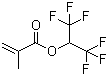 |
| Molecular Formula | C7H6F6O2 |
| Molecular Weight | 236.11 |
| CAS Registry Number | 3063-94-3 |
| EC Number | 221-309-9 |
| SMILES | CC(=C)C(=O)OC(C(F)(F)F)C(F)(F)F |
| Density | 1.3±0.1 g/cm3 Calc.*, 1.302 g/mL (Expl.) |
|---|---|
| Boiling point | 135.6±35.0 °C 760 mmHg (Calc.)*, 99 °C (Expl.) |
| Flash point | 14.4 °C (Calc.)*, 14 °C (Expl.) |
| Index of refraction | 1.339 (Calc.)*, 1.331 (Expl.) |
| * | Calculated using Advanced Chemistry Development (ACD/Labs) Software. |
| Hazard Symbols |   GHS02;GHS07 DangerGHS02; Details GHS02;GHS07 DangerGHS02; Details | ||||||||||||||||||||||||||||||||
|---|---|---|---|---|---|---|---|---|---|---|---|---|---|---|---|---|---|---|---|---|---|---|---|---|---|---|---|---|---|---|---|---|---|
| Risk Statements | H225-H302-H312-H315-H319-H332-H335 Details | ||||||||||||||||||||||||||||||||
| Safety Statements | P210-P233-P240-P241-P242-P243-P261-P264-P264+P265-P270-P271-P280-P301+P317-P302+P352-P303+P361+P353-P304+P340-P305+P351+P338-P317-P319-P321-P330-P332+P317-P337+P317-P362+P364-P370+P378-P403+P233-P403+P235-P405-P501 Details | ||||||||||||||||||||||||||||||||
| Hazard Classification | |||||||||||||||||||||||||||||||||
| |||||||||||||||||||||||||||||||||
| SDS | Available | ||||||||||||||||||||||||||||||||
 chemBlink Chemical Story
|
1,1,1,3,3,3-Hexafluoroisopropyl methacrylate is a fluorinated methacrylate ester belonging to the class of specialty acrylic monomers. The compound consists of a methacrylate polymerizable group connected through an ester linkage to a 1,1,1,3,3,3-hexafluoroisopropyl group. Its combination of a reactive vinyl functionality and a highly fluorinated substituent gives it distinctive properties that have supported its use in fluorine-containing polymer research and advanced materials development. The development of fluorinated methacrylate compounds was closely associated with the growth of polymer chemistry and the discovery that fluorine substitution can significantly alter the properties of organic materials. The introduction of fluorine atoms into polymer structures can affect surface characteristics, chemical resistance, thermal behavior, and optical properties. As synthetic methods for fluorinated alcohols and fluorinated monomers advanced, compounds such as 1,1,1,3,3,3-hexafluoroisopropyl methacrylate were prepared as functional monomers for producing fluorinated polymers. The molecular structure contains a methacrylate group, which consists of a carbon-carbon double bond conjugated with an ester carbonyl group. This unsaturated group is responsible for the compound’s polymerization capability. Under suitable conditions, the carbon-carbon double bond can undergo free-radical polymerization, allowing incorporation of the monomer into polymer chains. The hexafluoroisopropyl group contains six fluorine atoms attached to the two carbon atoms of an isopropyl framework. The high fluorine content strongly influences the electronic and physical properties of the molecule. Carbon-fluorine bonds are highly polarized and among the strongest bonds in organic chemistry, contributing to chemical stability and resistance to many forms of degradation. The fluorinated substituent also increases hydrophobicity and lowers the polarizability of the hydrocarbon framework compared with nonfluorinated analogues. Fluorinated groups often reduce surface energy in polymer materials, which can lead to properties such as water repellency and low adhesion. These characteristics have made fluorinated methacrylates valuable components in specialty polymer formulations. The main application of 1,1,1,3,3,3-hexafluoroisopropyl methacrylate is as a monomer for the preparation of fluorinated polymers and copolymers. By combining this monomer with other acrylic or methacrylic compounds, researchers can create materials with tailored combinations of mechanical, thermal, optical, and surface properties. Fluorinated polymers containing hexafluoroisopropyl groups have been investigated for use in coatings, optical materials, and surface modification technologies. The presence of fluorine can improve resistance to moisture, chemicals, and environmental exposure. In coating applications, fluorinated segments can migrate toward material surfaces, reducing surface energy and modifying wetting behavior. In optical materials research, fluorinated methacrylate polymers have been studied because fluorine substitution can influence refractive index, transparency, and material stability. These characteristics are relevant in the development of polymeric optical components and advanced photonic materials. The compound has also been examined in the field of high-performance polymer design. Fluorinated monomers are used to introduce specific properties into polymer systems while maintaining processability through copolymerization. The methacrylate functionality provides synthetic flexibility because it can be polymerized with a wide range of comonomers. The chemical reactivity of 1,1,1,3,3,3-hexafluoroisopropyl methacrylate is mainly associated with the methacrylate double bond. The fluorinated alcohol-derived portion is comparatively stable and generally functions as a structural component that modifies polymer properties rather than as a reactive site. Overall, 1,1,1,3,3,3-hexafluoroisopropyl methacrylate is a fluorinated methacrylate monomer developed for the synthesis of specialized fluorine-containing polymers. Its combination of polymerizable methacrylate functionality and a highly fluorinated substituent has made it useful in research and industrial development of advanced coatings, optical materials, and high-performance polymer systems. References 2024. Investigation of the Mechanical and Chemical Stability of Superhydrophobic Coatings Based on Reactive Copolymers of Glycidyl Methacrylate and Fluoroalkyl Methacrylates. Colloid Journal. DOI: 10.1134/s1061933x23601208 2022. Biodegradation Control of Chitosan Materials by Surface Modification with Copolymers of Glycidyl Methacrylate and Alkyl Methacrylates. Fibers and Polymers. DOI: 10.1007/s12221-022-4954-x 2019. Influence of the Composition of Graft Copolymers of Fluoroalkyl Methacrylates on Stability of the Superhydrophobic State of Stainless Steel Surface. Polymer Science, Series B. DOI: 10.1134/s156009041906006x |
| Market Analysis Reports |