
Online Database of Chemicals from Around the World
| Discovery Fine Chemicals Ltd. | UK | |||
|---|---|---|---|---|
 | www.discofinechem.com | |||
 | +44 (1202) 874-517 | |||
 | +44 (845) 094-4385 | |||
 | pjc@discofinechem.com | |||
| Chemical manufacturer | ||||
| chemBlink Standard supplier since 2009 | ||||
| Yacht Bio-Tech Co., Ltd. | China | |||
|---|---|---|---|---|
| www.yachtbio.com | |||
| +86 (28) 8533-5576 | |||
| +86 (28) 8533-5578 | |||
| post@yachtbio.com | |||
| Chemical manufacturer | ||||
| chemBlink Standard supplier since 2009 | ||||
| BOC Sciences | USA | |||
|---|---|---|---|---|
| www.bocsci.com | |||
| +1 (631) 485-4226 | |||
| +1 (631) 614-7828 | |||
| info@bocsci.com | |||
| Chemical manufacturer | ||||
| chemBlink Standard supplier since 2010 | ||||
| Valiant Co., Ltd. | China | |||
|---|---|---|---|---|
| www.valiant-cn.com | |||
| +86 (535) 610-1878 | |||
| +86 (535) 638-6989 | |||
| jiangyanan@valiant-cn.com chenxiaowei@valiant-cn.com | |||
| Chemical manufacturer since 1992 | ||||
| chemBlink Standard supplier since 2012 | ||||
| Selleck Chemicals LLC | USA | |||
|---|---|---|---|---|
| www.selleckchem.com | |||
| +1 (713) 535-9129 | |||
| +1 (832) 582-8590 | |||
| info@selleckchem.com | |||
| Chemical manufacturer | ||||
| chemBlink Standard supplier since 2014 | ||||
| Hangzhou Leap Chem Co., Ltd. | China | |||
|---|---|---|---|---|
| www.leapchem.com | |||
| +86 (571) 8771-1850 | |||
| market19@leapchem.com | |||
 | QQ Chat | |||
| Chemical manufacturer since 2006 | ||||
| chemBlink Standard supplier since 2015 | ||||
| Hunan Yunbang Biomedical Co., Ltd. | China | |||
|---|---|---|---|---|
| www.hunanyunbang.com | |||
| +86 (731) 8552-5705 +86 13319518603 | |||
| +86 (731) 8552-5705 | |||
| ivy@hnhbsj.com | |||
| QQ Chat | |||
 | Skype Chat | |||
| Chemical manufacturer since 2014 | ||||
| chemBlink Standard supplier since 2019 | ||||
| Cfm Oskar Tropitzsch GmbH | Germany | |||
|---|---|---|---|---|
| www.cfmot.de | |||
| +49 (9231) 9619-0 | |||
| +49 (9231) 9619-60 | |||
| info@cfmot.de | |||
| Chemical distributor since 1985 | ||||
| chemBlink Standard supplier since 2022 | ||||
| HuNan Huibaiyi New Materials Co; Ltd. | China | |||
|---|---|---|---|---|
| www.hbsjxcl.com | |||
| +86 13319523173 | |||
| ivy@hnhbsj.com | |||
| QQ Chat | |||
 | WeChat: 13319523173 | |||
| Chemical manufacturer since 2014 | ||||
| chemBlink Standard supplier since 2026 | ||||
| Indofine Chemical Company, Inc. | USA | |||
|---|---|---|---|---|
| www.indofinechemical.com | |||
| +1 (888) 463-6346 | |||
| +1 (908) 359-1179 | |||
| info@indofinechemical.com | |||
| Chemical manufacturer since 1981 | ||||
| Generay Biotech (Shanghai) Co., Ltd. | China | |||
|---|---|---|---|---|
| www.generay.com.cn | |||
| +86 (21) 6762-6003 6762-6050 6762-6120 | |||
| +86 (21) 6762-6011 | |||
| order@generay.com.cn | |||
| Chemical manufacturer | ||||
| LKT Laboratories, Inc. | USA | |||
|---|---|---|---|---|
| www.lktlabs.com | |||
| +1 (888) 558-5227 | |||
| +1 (651) 644-8357 | |||
| peacerli@mbolin-lktlabs.com | |||
| Chemical manufacturer | ||||
| Chemos GmbH & Co. KG | Germany | |||
|---|---|---|---|---|
| www.chemos.de | |||
| +49 871-966346-0 | |||
| +49 871-966346-13 | |||
| chemos@chemos.de | |||
| Chemical distributor | ||||
| Anisyn, Inc. | USA | |||
|---|---|---|---|---|
| www.anisyn.com | |||
| +1 (269) 372-8736 | |||
| +1 (269) 372-3397 | |||
| sales@anisyn.com | |||
| Chemical manufacturer | ||||
| Melford Laboratories Limited | UK | |||
|---|---|---|---|---|
| www.melford.co.uk | |||
| +44 (1449) 741-178 | |||
| +44 (1449) 741-217 | |||
| pfranklin@melford.co.uk sales@melford.co.uk | |||
| Chemical manufacturer since 1985 | ||||
| Classification | API >> Antibiotics >> Other antibiotics |
|---|---|
| Name | Hygromycin B |
| Synonyms | O-6-Amino-6-deoxy-L-glycero-D-galacto-heptopyranosylidene-(1-2-3)-o-beta-D-talopyranosyl-(1-5)-2-deoxy-N3-methyl-D-streptamine |
| Molecular Structure | 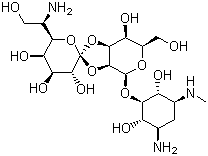 |
| Molecular Formula | C20H37N3O13 |
| Molecular Weight | 527.52 |
| CAS Registry Number | 31282-04-9 |
| EC Number | 250-545-5 |
| SMILES | CN[C@H]1C[C@H]([C@@H]([C@H]([C@@H]1O)O[C@H]2[C@@H]3[C@H]([C@H]([C@H](O2)CO)O)OC4(O3)[C@@H]([C@H]([C@H]([C@H](O4)[C@H](CO)N)O)O)O)O)N |
| Density | 1.7±0.1 g/cm3 Calc.* |
|---|---|
| Melting point | 160-180 °C (Expl.) |
| Boiling point | 897.6±65.0 °C 760 mmHg (Calc.)* |
| Flash point | 496.7±34.3 °C (Calc.)* |
| Index of refraction | 1.672 (Calc.)* |
| * | Calculated using Advanced Chemistry Development (ACD/Labs) Software. |
| Hazard Symbols |     GHS05;GHS06;GHS07;GHS08 Danger Details GHS05;GHS06;GHS07;GHS08 Danger Details | ||||||||||||||||||||||||||||||||||||||||||||||||||||
|---|---|---|---|---|---|---|---|---|---|---|---|---|---|---|---|---|---|---|---|---|---|---|---|---|---|---|---|---|---|---|---|---|---|---|---|---|---|---|---|---|---|---|---|---|---|---|---|---|---|---|---|---|---|
| Risk Statements | H300+H310+H330-H300-H310-H317-H318-H330-H334 Details | ||||||||||||||||||||||||||||||||||||||||||||||||||||
| Safety Statements | P233-P260-P261-P262-P264-P264+P265-P270-P271-P272-P280-P284-P301+P316-P302+P352-P304+P340-P305+P354+P338-P316-P317-P320-P321-P330-P333+P317-P342+P316-P361+P364-P362+P364-P403-P403+P233-P405-P501 Details | ||||||||||||||||||||||||||||||||||||||||||||||||||||
| Hazard Classification | |||||||||||||||||||||||||||||||||||||||||||||||||||||
| |||||||||||||||||||||||||||||||||||||||||||||||||||||
| Transport Information | UN 3462 | ||||||||||||||||||||||||||||||||||||||||||||||||||||
| SDS | Available | ||||||||||||||||||||||||||||||||||||||||||||||||||||
 chemBlink Chemical Story
|
Hygromycin B is a naturally occurring aminoglycoside antibiotic produced by certain strains of *Streptomyces hygroscopicus*. It is a complex polyfunctional organic molecule composed of multiple sugar-like rings, amino groups, and hydroxyl substituents, forming a highly polar structure that interacts strongly with biological macromolecules, particularly the ribosome. Structurally, hygromycin B belongs to the aminoglycoside class, which is characterized by amino-modified sugars linked through glycosidic bonds. The molecule contains a central aminocyclitol core (a sugar-like cyclic polyol containing nitrogen) attached to several amino sugar residues. These structural motifs are heavily functionalized with hydroxyl (–OH) and amino (–NH2 or protonated –NH3+) groups, giving the molecule extensive hydrogen-bonding capacity and high water solubility. The abundance of hydroxyl groups throughout the structure makes hygromycin B highly polar. These hydroxyl groups can act as both hydrogen-bond donors and acceptors, enabling strong interactions with polar biological environments such as nucleic acids and proteins. The amino groups, which are often protonated under physiological conditions, contribute positive charges that enhance electrostatic interactions with negatively charged biomolecules such as RNA. A key structural feature of hygromycin B is its conformational rigidity in certain ring systems combined with flexible glycosidic linkages between sugar-like units. This combination allows the molecule to adopt conformations that fit into the binding site of the ribosome, particularly the A-site region of the 30S subunit in prokaryotic ribosomes and the corresponding functional region in eukaryotic ribosomes. The biological activity of hygromycin B arises from its ability to interfere with protein synthesis. It binds to ribosomal RNA and disrupts the accuracy of translation. Specifically, it inhibits translocation and causes misreading of mRNA during protein synthesis. This leads to the production of abnormal or truncated proteins, ultimately resulting in inhibition of cell growth and cell death at sufficient concentrations. The mechanism of action is closely related to its structural complementarity with ribosomal RNA. The multiple amino and hydroxyl groups form a network of hydrogen bonds and electrostatic interactions with phosphate groups and nucleotide bases in ribosomal RNA. This strong binding affinity underlies its antibiotic potency. Because of its potent inhibitory effects on protein synthesis, hygromycin B is also widely used as a selective agent in molecular biology. Cells that express resistance genes (commonly encoding hygromycin phosphotransferase enzymes) can inactivate the antibiotic through phosphorylation, allowing them to survive in its presence. This property makes hygromycin B an important selectable marker in genetic engineering and cell culture experiments. Physicochemically, hygromycin B is highly hydrophilic due to its dense functionalization with polar groups. It is typically soluble in water but has low permeability through lipid membranes without transport mechanisms, reflecting its charged and polar nature. Chemically, the molecule is relatively stable under mild conditions, although the glycosidic linkages and amino sugar functionalities can be susceptible to degradation under strong acidic or enzymatic conditions. Its primary mode of chemical activity, however, is not general reactivity but highly specific binding to ribosomal RNA structures. Overall, hygromycin B is a complex aminoglycoside antibiotic composed of multiple amino sugars and polyhydroxylated ring systems. Its strong binding to ribosomal RNA disrupts protein synthesis, making it both a potent antimicrobial agent and a widely used selection reagent in molecular and cellular biology. References 2026. Structural and molecular basis of specialized translation mediated by the ribosome mRNA-binding channel. Nature Communications. DOI: 10.1038/s41467-026-72263-5 2025. Deciphering hygromycin B biosynthetic pathway and D-optimal design for production optimization. World Journal of Microbiology and Biotechnology. DOI: 10.1007/s11274-025-04364-0 2025. Hygromycin A Treatment of Borrelia burgdorferi –Infected Peromyscus leucopus Suggests Potential as a Reservoir-Targeted Antibiotic. The Journal of Infectious Diseases. DOI: 10.1093/infdis/jiaf363 |
| Market Analysis Reports |