
Online Database of Chemicals from Around the World
| Bio-sugars Technology Co., Ltd. | China | |||
|---|---|---|---|---|
 | www.bio-sugars.com | |||
 | +86 (579) 8901-8388 +86 15167971485 | |||
 | +86 (579) 8855-6787 | |||
 | syngars@hotmail.com | |||
 | QQ Chat | |||
| Chemical manufacturer since 2008 | ||||
| chemBlink Standard supplier since 2006 | ||||
| Beijing Ribio Biotech. Inc. | China | |||
|---|---|---|---|---|
| www.ribio.com.cn | |||
| +86 (10) 6266-4360 +86 13910960639 | |||
| +86 (10) 6266-4370 | |||
| sales@ribio.com.cn ribio@163.com | |||
| QQ Chat | |||
| Chemical manufacturer since 2007 | ||||
| chemBlink Standard supplier since 2007 | ||||
| Nanjing Search Biotech Co., Ltd. | China | |||
|---|---|---|---|---|
| www.searchbio.com.cn | |||
| +86 (25) 8168-2922 8586-0978 +86 18913919581 | |||
| +86 (25) 8586-0962 | |||
| trade@searchbio.com.cn sales@searchbio.com.cn Linda@searchbio.com.cn | |||
| QQ Chat | |||
| Chemical manufacturer since 2007 | ||||
| chemBlink Standard supplier since 2007 | ||||
| Zibo Feiyang Biotechnology Co., Ltd. | China | |||
|---|---|---|---|---|
| www.chemfy.com | |||
| +86 (533) 736-9098 | |||
| +86 (533) 736-9099 | |||
| sales@chemfy.com dudeliang@hotmail.com | |||
| Chemical manufacturer | ||||
| chemBlink Standard supplier since 2008 | ||||
| Extrasynthese Chemical S.A.S. | France | |||
|---|---|---|---|---|
| www.extrasynthese.com | |||
| +33 (47) 898-2034 | |||
| +33 (47) 898-1945 | |||
| info@extrasynthese.com | |||
| Chemical manufacturer | ||||
| chemBlink Standard supplier since 2009 | ||||
| Biosynth AG. | Switzerland | |||
|---|---|---|---|---|
| www.biosynth.com | |||
| +41 (71) 858-2020 | |||
| +41 (71) 858-2030 | |||
| welcome@biosynth.ch | |||
| Chemical manufacturer | ||||
| chemBlink Standard supplier since 2014 | ||||
| Hangzhou Leap Chem Co., Ltd. | China | |||
|---|---|---|---|---|
| www.leapchem.com | |||
| +86 (571) 8771-1850 | |||
| market19@leapchem.com | |||
| QQ Chat | |||
| Chemical manufacturer since 2006 | ||||
| chemBlink Standard supplier since 2015 | ||||
| Hunan Yunbang Biomedical Co., Ltd. | China | |||
|---|---|---|---|---|
| www.hunanyunbang.com | |||
| +86 (731) 8552-5705 +86 13319518603 | |||
| +86 (731) 8552-5705 | |||
| ivy@hnhbsj.com | |||
| QQ Chat | |||
 | Skype Chat | |||
| Chemical manufacturer since 2014 | ||||
| chemBlink Standard supplier since 2019 | ||||
| HuNan Huibaiyi New Materials Co; Ltd. | China | |||
|---|---|---|---|---|
| www.hbsjxcl.com | |||
| +86 13319523173 | |||
| ivy@hnhbsj.com | |||
| QQ Chat | |||
 | WeChat: 13319523173 | |||
| Chemical manufacturer since 2014 | ||||
| chemBlink Standard supplier since 2026 | ||||
| Melford Laboratories Limited | UK | |||
|---|---|---|---|---|
| www.melford.co.uk | |||
| +44 (1449) 741-178 | |||
| +44 (1449) 741-217 | |||
| pfranklin@melford.co.uk sales@melford.co.uk | |||
| Chemical manufacturer since 1985 | ||||
| Indofine Chemical Company, Inc. | USA | |||
|---|---|---|---|---|
| www.indofinechemical.com | |||
| +1 (888) 463-6346 | |||
| +1 (908) 359-1179 | |||
| info@indofinechemical.com | |||
| Chemical manufacturer since 1981 | ||||
| Chemos GmbH & Co. KG | Germany | |||
|---|---|---|---|---|
| www.chemos.de | |||
| +49 871-966346-0 | |||
| +49 871-966346-13 | |||
| chemos@chemos.de | |||
| Chemical distributor | ||||
| Classification | Biochemical >> Carbohydrate >> Monosaccharide |
|---|---|
| Name | 4-Nitrophenyl-beta-D-galactopyranoside |
| Synonyms | (2R,3R,4S,5R,6S)-2-(hydroxymethyl)-6-(4-nitrophenoxy)oxane-3,4,5-triol |
| Molecular Structure | 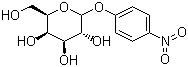 |
| Molecular Formula | C12H15NO8 |
| Molecular Weight | 301.25 |
| CAS Registry Number | 3150-24-1 |
| EC Number | 221-584-5 |
| SMILES | C1=CC(=CC=C1[N+](=O)[O-])O[C@H]2[C@@H]([C@H]([C@H]([C@H](O2)CO)O)O)O |
| Density | 1.6±0.1 g/cm3 Calc.* |
|---|---|
| Melting point | 166 - 169 °C (Expl.) |
| Boiling point | 582.2±50.0 °C 760 mmHg (Calc.)* |
| Flash point | 305.9±30.1 °C (Calc.)* |
| Index of refraction | 1.648 (Calc.)* |
| * | Calculated using Advanced Chemistry Development (ACD/Labs) Software. |
| Hazard Symbols |  GHS07 Warning Details GHS07 Warning Details |
|---|---|
| Risk Statements | H302-H315-H319-H335 Details |
| Safety Statements | P261-P305+P351+P338 Details |
| SDS | Available |
 chemBlink Chemical Story
|
4-Nitrophenyl-β-D-galactopyranoside (commonly abbreviated as ONPG when referring to related analogs, though ONPG specifically is the ortho-nitrophenyl derivative) is a synthetic glycoside composed of a β-D-galactopyranose sugar linked through a glycosidic bond to a 4-nitrophenyl aglycone. It is widely used as a chromogenic substrate in enzymatic assays for detecting β-galactosidase activity. Structurally, the molecule consists of two main components: a carbohydrate moiety (β-D-galactopyranose) and an aromatic phenyl group substituted with a nitro group at the para position. The galactopyranose unit is a six-membered ring sugar derived from galactose, containing multiple hydroxyl groups arranged in a defined stereochemical configuration. These hydroxyl groups contribute extensive hydrogen-bonding capability and high polarity. The glycosidic linkage is a β-linkage, meaning the substituent attached to the anomeric carbon (C1) of the sugar is oriented in the same stereochemical direction as the C5 substituent in the D-sugar configuration. This stereochemistry is critical for recognition by β-galactosidase enzymes, which specifically hydrolyze β-linked galactosides. The aglycone portion is 4-nitrophenyl, an aromatic ring bearing a nitro group (–NO2) at the para position relative to the glycosidic oxygen linkage. The nitro group is a strongly electron-withdrawing substituent that stabilizes negative charge through resonance and inductive effects. It also significantly influences the electronic absorption properties of the molecule and, more importantly, of the released product after enzymatic cleavage. In enzymatic reactions, β-galactosidase catalyzes hydrolysis of the glycosidic bond, releasing free 4-nitrophenol and D-galactose. Upon release, 4-nitrophenol can undergo deprotonation under alkaline conditions to form the 4-nitrophenolate ion, which exhibits a strong yellow color due to extended conjugation and altered electron distribution. This color change forms the basis for spectrophotometric measurement of enzymatic activity. The galactopyranose ring exists predominantly in stable chair conformations, which minimize steric strain and allow optimal arrangement of hydroxyl groups. These hydroxyl groups participate in hydrogen bonding with solvent molecules and with amino acid residues in enzyme active sites during substrate recognition. The aromatic ring of the aglycone contributes hydrophobic character, while the nitro substituent introduces polarity and strong electron-withdrawing effects. This combination allows the molecule to remain sufficiently soluble in aqueous environments while still providing a chromogenic response upon enzymatic cleavage. Physicochemically, 4-nitrophenyl-β-D-galactopyranoside is a polar compound due to the multiple hydroxyl groups on the sugar moiety. It is highly water-compatible and is typically used in buffered aqueous solutions for biochemical assays. The glycosidic bond itself is stable under neutral conditions but is selectively cleaved by β-galactosidase enzymes. Chemically, the most important transformation is hydrolysis of the glycosidic linkage. The aromatic nitro group remains intact during enzymatic cleavage but plays a crucial role in stabilizing the chromogenic product formed after release of 4-nitrophenol. The resulting phenolate species exhibits increased conjugation and a strong absorbance in the visible region. Overall, 4-nitrophenyl-β-D-galactopyranoside is a synthetic β-galactoside substrate composed of a galactose-derived sugar linked to a para-nitrophenyl group. Its structure is designed to enable enzymatic cleavage by β-galactosidase and produce a measurable color change, making it a widely used reagent in biochemical and molecular biology assays. References 2025. Psychromicrobium ferritrahens sp. nov., A Novel Actinobacterium Isolated from Decayed Wood in Shizong County, China. Current Microbiology. DOI: 10.1007/s00284-025-04698-w 2025. Substrate-selective nanofactories constructed from enzyme-loaded thermoresponsive peptoid-b-oligosaccharide vesicles. Polymer Journal. DOI: 10.1038/s41428-025-01116-7 2024. Roseobacter sinensis sp. nov., a marine bacterium capable to synthesize arachidonic acid. Antonie van Leeuwenhoek. DOI: 10.1007/s10482-024-02034-z |
| Market Analysis Reports |