
Online Database of Chemicals from Around the World
| wuhan chemi Pharmacy Chemical Technology Co., Ltd. | China | |||
|---|---|---|---|---|
 | www.chemipharm.com.cn | |||
 | +86 13971619949 | |||
 | gmn424@chemipharm.com.cn | |||
 | QQ Chat | |||
 | WeChat: 13971619949 | |||
| Chemical manufacturer since 2014 | ||||
| chemBlink Standard supplier since 2026 | ||||
| Classification | Organic raw materials >> Ketone compound |
|---|---|
| Name | 2-Hydroxy-9H-thioxanthen-9-one |
| Synonyms | 2-Hydroxythioxanthen-9-one; 2-Hydroxythioxanthone |
| Molecular Structure | 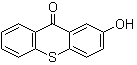 |
| Molecular Formula | C13H8O2S |
| Molecular Weight | 228.27 |
| CAS Registry Number | 31696-67-0 |
| EC Number | 815-134-2 |
| SMILES | C1=CC=C2C(=C1)C(=O)C3=C(S2)C=CC(=C3)O |
| Density | 1.4±0.1 g/cm3 Calc.* |
|---|---|
| Boiling point | 424.5±34.0 °C 760 mmHg (Calc.)* |
| Flash point | 210.5±25.7 °C (Calc.)* |
| Index of refraction | 1.729 (Calc.)* |
| * | Calculated using Advanced Chemistry Development (ACD/Labs) Software. |
| Hazard Symbols |  GHS07 Warning Details GHS07 Warning Details |
|---|---|
| Risk Statements | H302-H315-H319-H335 Details |
| Safety Statements | P261-P305+P351+P338 Details |
| SDS | Available |
 chemBlink Chemical Story
|
2-Hydroxy-9H-thioxanthen-9-one is a sulfur-containing polycyclic aromatic compound belonging to the thioxanthone family. It consists of a tricyclic thioxanthone core, in which a sulfur atom bridges two benzene rings, and a carbonyl group at the 9-position, along with a hydroxyl substituent at the 2-position. Thioxanthones are structurally related to xanthones, with sulfur replacing the oxygen atom in the central heterocycle, and they are well known for their photochemical and photophysical properties. The thioxanthone scaffold has been studied extensively in organic chemistry and photochemistry due to its strong light absorption in the ultraviolet region and its ability to act as a photoinitiator in radical polymerization processes. The conjugated tricyclic system provides a rigid, planar aromatic framework that enables efficient delocalization of π-electrons, contributing to its characteristic electronic absorption behavior. In 2-hydroxy-9H-thioxanthen-9-one, the hydroxyl group at the 2-position introduces an additional site for hydrogen bonding and modifies the electronic distribution of the aromatic system. The hydroxyl substituent can participate in intramolecular hydrogen bonding with the adjacent carbonyl oxygen, depending on molecular conformation, which can influence both spectral properties and reactivity. Such intramolecular interactions are commonly observed in hydroxylated aromatic ketones and often affect their photochemical behavior. The carbonyl group at the 9-position is a defining feature of the thioxanthone core and plays a central role in its excited-state chemistry. Upon absorption of ultraviolet light, the molecule undergoes electronic excitation, and the carbonyl group is involved in n→π* and π→π* transitions that contribute to intersystem crossing and formation of reactive excited states. These properties make thioxanthone derivatives effective photosensitizers and photoinitiators. Thioxanthone compounds, including hydroxylated derivatives, are widely used in industrial photopolymerization processes, such as UV-curing of coatings, inks, and adhesives. In these applications, they absorb UV light and generate reactive radical species either directly or through interaction with co-initiators. The efficiency of these processes is strongly influenced by substituents on the aromatic rings, which modulate absorption wavelength, quantum yield, and photostability. The presence of sulfur in the central ring distinguishes thioxanthones from their oxygen analogues (xanthones) by altering electronic properties such as polarizability and intersystem crossing efficiency. Sulfur, being a heavier atom, enhances spin–orbit coupling, which promotes transitions between singlet and triplet excited states. This contributes to the high photochemical activity of thioxanthone derivatives. From a physicochemical perspective, 2-hydroxy-9H-thioxanthen-9-one is a relatively hydrophobic aromatic compound with localized polarity due to the hydroxyl and carbonyl groups. The planar tricyclic structure promotes π–π stacking interactions in the solid state, which can influence crystallinity and melting behavior. The hydroxyl group can also influence solubility in polar organic solvents through hydrogen bonding interactions. The synthesis of thioxanthone derivatives typically involves cyclization strategies that construct the tricyclic core, often starting from diphenyl sulfide derivatives followed by oxidative cyclization to introduce the carbonyl functionality. Subsequent functionalization allows introduction of substituents such as hydroxyl groups at specific positions on the aromatic framework. In addition to industrial photochemistry, thioxanthone derivatives have been investigated in academic research for their photophysical properties and potential biological activities. Their ability to generate excited-state species makes them useful probes in studies of energy transfer, photoreactivity, and radical formation. Overall, 2-hydroxy-9H-thioxanthen-9-one is a hydroxyl-substituted thioxanthone characterized by a rigid sulfur-bridged tricyclic aromatic system and a photochemically active carbonyl group. Its significance lies in its role as a UV-absorbing compound and photoinitiator, as well as its broader relevance in the study of conjugated aromatic systems and excited-state chemistry. References 2014. Mercaptoalkoxy-thioxanthones as a novel photoinitiator for free radical polymerization. Polymer Bulletin. DOI: 10.1007/s00289-014-1270-7 |
| Market Analysis Reports |