
Online Database of Chemicals from Around the World
| BOC Sciences | USA | |||
|---|---|---|---|---|
 | www.bocsci.com | |||
 | +1 (631) 485-4226 | |||
 | +1 (631) 614-7828 | |||
 | info@bocsci.com | |||
| Chemical manufacturer | ||||
| chemBlink Standard supplier since 2010 | ||||
| Intatrade Chemicals GmbH | Germany | |||
|---|---|---|---|---|
| www.intatrade.de | |||
| +49 (3493) 605-465 | |||
| +49 (3493) 605-470 | |||
| sales@intatrade.de | |||
| Chemical distributor | ||||
| chemBlink Standard supplier since 2011 | ||||
| Suzhou Myland Pharm & Nutrition Inc. | China | |||
|---|---|---|---|---|
| www.mylandpharm.com | |||
| +86 (512) 6615-0687 | |||
| +86 (512) 6615-7101 | |||
| info@mylandpharm.com | |||
 | QQ Chat | |||
| Chemical manufacturer since 2013 | ||||
| chemBlink Standard supplier since 2014 | ||||
| Hangzhou Leap Chem Co., Ltd. | China | |||
|---|---|---|---|---|
| www.leapchem.com | |||
| +86 (571) 8771-1850 | |||
| market19@leapchem.com | |||
| QQ Chat | |||
| Chemical manufacturer since 2006 | ||||
| chemBlink Standard supplier since 2015 | ||||
| Nextpeptide Inc. | China | |||
|---|---|---|---|---|
| www.nextpeptide.com | |||
| +86 (571) 8161-2335 | |||
| sales@nextpeptide.com | |||
| Chemical distributor since 2017 | ||||
| chemBlink Standard supplier since 2017 | ||||
| Tocris Bioscience Inc. | USA | |||
|---|---|---|---|---|
| www.tocris.com | |||
| +1 (636) 207-7651 | |||
| +1 (636) 207-7683 | |||
| customerservice.na@bio-techne.com | |||
| Chemical manufacturer since 1982 | ||||
| Watanabe Chemical Ind., Ltd. | Japan | |||
|---|---|---|---|---|
| www.watanabechem.co.jp | |||
| +81 (82) 231-0540 | |||
| +81 (82) 231-1451 | |||
| inquiry@watanabechem.co.jp | |||
| Chemical manufacturer | ||||
| Classification | Chemical reagent >> Organic reagent >> Amide |
|---|---|
| Name | N-Acetyl-L-cysteinamide |
| Synonyms | N-Acetylcysteine amide; Naca |
| Molecular Structure | 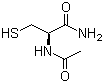 |
| Molecular Formula | C5H10N2O2S |
| Molecular Weight | 162.21 |
| Protein Sequence | C |
| CAS Registry Number | 38520-57-9 |
| EC Number | 686-019-0 |
| SMILES | CC(=O)N[C@@H](CS)C(=O)N |
| Solubility | Sparingly soluble (26 g/L) (25 °C), Calc.* |
|---|---|
| Density | 1.226±0.06 g/cm3 (20 °C 760 Torr), Calc.* |
| Melting point | 147-149 °C (ethanol )** |
| Boiling point | 441.0±40.0 °C 760 mmHg (Calc.)* |
| Flash point | 220.5±27.3 °C (Calc.)* |
| Index of refraction | 1.521 (Calc.)* |
| * | Calculated using Advanced Chemistry Development (ACD/Labs) Software V11.02 (©1994-2015 ACD/Labs) |
| ** | Bernardes, Goncalo J. L. |
| Hazard Symbols |  GHS07 Warning Details GHS07 Warning Details | ||||||||
|---|---|---|---|---|---|---|---|---|---|
| Risk Statements | H302 Details | ||||||||
| Safety Statements | P264-P270-P301+P317-P330-P501 Details | ||||||||
| Hazard Classification | |||||||||
| |||||||||
| SDS | Available | ||||||||
 chemBlink Chemical Story
|
N-Acetyl-L-cysteinamide is a small sulfur-containing organic compound derived from the amino acid L-cysteine. Structurally, it is an N-acetylated amide derivative in which the amino group of cysteine is acetylated and the carboxylic acid group is converted into an amide. As a result, the molecule contains a thioether-related thiol side chain, an acetamide group, and a terminal carboxamide functionality. The parent amino acid, L-cysteine, contains three key functional elements: an amino group, a carboxylic acid group, and a thiol (–SH) side chain. In N-acetyl-L-cysteinamide, the amino group is modified by acetylation, forming an amide bond with an acetyl group. In addition, the carboxylic acid is converted into a carboxamide, replacing the acidic hydroxyl functionality with an amide nitrogen. These transformations significantly reduce the zwitterionic character typical of amino acids. The thiol group remains the most chemically significant feature of the molecule. Sulfur-containing thiols are nucleophilic and can participate in redox reactions, disulfide bond formation, and metal coordination chemistry. In biological systems, thiols are important in maintaining redox balance and participating in enzymatic catalysis. The presence of the thiol group also strongly influences the compound’s reactivity and oxidation susceptibility. The amide functional groups in the molecule are stabilized by resonance between the carbonyl oxygen and nitrogen, which reduces their reactivity compared with free amines or carboxylic acids. Amide bonds are generally stable under neutral conditions but can undergo hydrolysis under strongly acidic or basic environments. The acetyl group on the nitrogen further decreases basicity and nucleophilicity of the amino nitrogen. From a structural perspective, N-Acetyl-L-cysteinamide is relatively small and flexible, with no rigid aromatic or ring systems. Its conformational behavior is primarily governed by rotation around single bonds in the carbon chain and the amide linkages. Hydrogen bonding capability is present through the amide carbonyls and the thiol group, although overall polarity is reduced compared with free cysteine due to amide formation. The compound contains both polar and moderately nonpolar features. The amide groups contribute polarity and hydrogen-bonding capacity, while the carbon backbone and sulfur atom contribute hydrophobic character. The thiol group also increases polarizability due to the larger size and diffuse electron cloud of sulfur compared with oxygen. Chemically, thiols are prone to oxidation, often forming disulfides under mild oxidizing conditions. This reactivity is an important aspect of sulfur amino acid chemistry. The extent to which N-acetylation and amidation affect redox behavior depends on environmental conditions, but the thiol group remains the primary reactive site. Without specific verified literature on this exact compound, no claims can be made regarding biological function or applications. Based on established structural chemistry, N-Acetyl-L-cysteinamide can be described as a small, sulfur-containing amino acid derivative featuring an acetylated amide nitrogen, a carboxamide terminus, and a reactive thiol side chain that governs its key chemical properties. References 2023. A de novo heterozygous variant in ACOX1 gene cause Mitchell syndrome: the first case in China and literature review. BMC Medical Genomics. DOI: https://www.ncbi.nlm.nih.gov/pmc/articles/PMC10318832 2012. Protective Effects of N -Acetylcysteine Amide (NACA) on Gentamicin-Induced Apoptosis in LLC-PK1 Cells. Renal Failure. DOI: https://pubmed.ncbi.nlm.nih.gov/22486232 2012. Characterizing N-acetylcysteine (NAC) and N-acetylcysteine amide (NACA) binding for lead poisoning treatment. Journal of Colloid and Interface Science. DOI: https://www.ncbi.nlm.nih.gov/pmc/articles/PMC3342509 |
| Market Analysis Reports |