
Online Database of Chemicals from Around the World
| Changzhou Ditong Chemical Co., Ltd. | China | |||
|---|---|---|---|---|
 | www.edengenechem.com | |||
 | +86 (519) 8829-8848 +86 18118010980 | |||
 | info@edengenechem.com sale@edengenechem.com | |||
 | QQ Chat | |||
 | WeChat: 18118010980 | |||
| Chemical manufacturer since 2006 | ||||
| chemBlink Premium supplier since 2026 | ||||

| Hangzhou Verychem Science And Technology Co., Ltd. | China | |||
|---|---|---|---|---|
| www.verychem.com | |||
| +86 (571) 8816-2785 +86 13606544505 | |||
 | +86 (571) 8816-2787 | |||
| lucy@verychem.com | |||
| Chemical manufacturer since 2004 | ||||
| chemBlink Massive supplier since 2021 | ||||
| Classification | Organic raw materials >> Ketone compound |
|---|---|
| Name | 2-Chloro-4'-bromoacetophenone |
| Synonyms | 1-(4-Bromophenyl)-2-chloroethan-1-one |
| Molecular Structure | 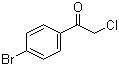 |
| Molecular Formula | C8H6BrClO |
| Molecular Weight | 233.49 |
| CAS Registry Number | 4209-02-3 |
| EC Number | 224-134-6 |
| SMILES | C1=CC(=CC=C1C(=O)CCl)Br |
| Density | 1.6±0.1 g/cm3 Calc.* |
|---|---|
| Boiling point | 306.7±22.0 °C 760 mmHg (Calc.)* |
| Flash point | 139.3±22.3 °C (Calc.)* |
| Index of refraction | 1.571 (Calc.)* |
| * | Calculated using Advanced Chemistry Development (ACD/Labs) Software. |
| Hazard Symbols |  GHS07 Warning Details GHS07 Warning Details | ||||||||||||||||
|---|---|---|---|---|---|---|---|---|---|---|---|---|---|---|---|---|---|
| Risk Statements | H315-H319-H335 Details | ||||||||||||||||
| Safety Statements | P261-P264-P264+P265-P271-P280-P302+P352-P304+P340-P305+P351+P338-P319-P321-P332+P317-P337+P317-P362+P364-P403+P233-P405-P501 Details | ||||||||||||||||
| Hazard Classification | |||||||||||||||||
| |||||||||||||||||
| SDS | Available | ||||||||||||||||
 chemBlink Chemical Story
|
2-Chloro-4'-bromoacetophenone is a halogenated aromatic ketone belonging to the class of substituted acetophenone derivatives. The compound contains an acetophenone framework with a chlorine substituent on the alpha carbon of the carbonyl group and a bromine substituent at the para position of the aromatic ring. Its structure combines the reactivity of an alpha-haloketone with the electronic characteristics of a brominated aromatic system, making it useful as an intermediate in organic synthesis. The acetophenone framework has been widely studied in organic chemistry because aromatic ketones are versatile starting materials for the preparation of numerous chemical compounds. The development of substituted acetophenones has provided synthetic chemists with molecules containing adjustable electronic and steric properties. Halogenated acetophenone derivatives, including 2-chloro-4'-bromoacetophenone, have been prepared as building blocks for further chemical transformations. The molecular structure consists of a benzene ring attached to an acetyl-derived carbonyl group. In this compound, the carbon adjacent to the carbonyl group contains a chlorine atom, forming an alpha-chloro ketone structure. The benzene ring carries a bromine substituent at the 4' position relative to the carbonyl-containing side chain, creating a para-brominated aromatic system. The carbonyl group is the central reactive functionality of the molecule. The carbonyl carbon is electrophilic because of polarization of the carbon-oxygen double bond. This allows the ketone to participate in nucleophilic addition reactions and other transformations typical of carbonyl compounds. The alpha-chlorine substituent increases the reactivity of the carbonyl system by influencing the electronic environment around the carbonyl carbon. The alpha-chloro ketone structure is particularly important in organic synthesis. Alpha-haloketones are widely used intermediates because the carbon bearing the halogen can undergo substitution reactions with nucleophiles. These reactions allow conversion of the alpha-chloro ketone into a variety of functionalized compounds, including heterocyclic molecules and other carbonyl derivatives. The para-bromine substituent on the aromatic ring provides an additional site for chemical modification. Carbon-bromine bonds in aromatic compounds can participate in transition-metal-catalyzed coupling reactions, allowing replacement of the bromine atom with carbon or heteroatom substituents. This feature makes brominated aromatic compounds valuable intermediates in the construction of more complex molecular structures. The aromatic ring contributes stability through its conjugated pi-electron system. The bromine substituent affects the electronic properties of the ring through inductive electron withdrawal and weak resonance interactions. The chlorine atom on the alpha carbon also influences the overall electron distribution but does not participate directly in aromatic conjugation. 2-Chloro-4'-bromoacetophenone has been used primarily as a synthetic intermediate. Alpha-haloketones are important starting materials in the preparation of heterocycles such as thiazoles, imidazoles, and related nitrogen- and sulfur-containing compounds. The combination of alpha-chloro ketone reactivity and aryl bromide functionality provides opportunities for sequential chemical transformations. In pharmaceutical and materials chemistry research, halogenated aromatic intermediates are frequently used because halogen atoms can be introduced deliberately to control molecular properties or provide handles for later functionalization. Compounds containing both aromatic bromine and alpha-halogenated carbonyl groups offer multiple pathways for structural diversification. The physical and chemical properties of 2-chloro-4'-bromoacetophenone are determined by the interaction of its aromatic ring, halogen substituents, and carbonyl group. The molecule contains polar carbonyl and carbon-halogen bonds, while the aromatic framework provides hydrophobic character. The absence of hydrogen-bond donor groups means its intermolecular interactions are mainly governed by dipole interactions and aromatic forces. Overall, 2-chloro-4'-bromoacetophenone is a multifunctional halogenated acetophenone derivative whose importance lies in its use as an organic synthesis intermediate. Its alpha-chloro ketone functionality provides high synthetic reactivity, while the para-brominated aromatic ring offers additional opportunities for chemical modification, making it a valuable building block in the preparation of more complex organic compounds. References 2021. Oxychlorination. Science of Synthesis. URL: https://science-of-synthesis.thieme.com/app/text/?id=SD-236-00105 2021. Convergent Paired Electrolysis. Science of Synthesis. URL: https://science-of-synthesis.thieme.com/app/text/?id=SD-236-00334 2020. Convergent Synthesis of Immune Inhibitor IMMH002. Synthesis. DOI: 10.1055/s-0040-1706299 |
| Market Analysis Reports |