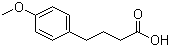
4-(4-Methoxyphenyl)butyric acid is an aromatic carboxylic acid consisting of a butyric acid side chain attached to a para-methoxy-substituted phenyl ring. It belongs to the class of phenylalkanoic acid derivatives and contains both an aromatic ether functionality and a terminal carboxylic acid group, giving it a combination of hydrophobic and polar structural features.
The core structure is a phenyl ring substituted at the para position with a methoxy group (–OCH3) and connected through a four-carbon aliphatic chain to a carboxylic acid group (–COOH). The phenyl ring provides a planar, aromatic system with delocalized π-electrons, contributing hydrophobic character and structural rigidity.
The methoxy substituent at the 4-position of the aromatic ring is an electron-donating group through resonance. The oxygen atom in the methoxy group can donate electron density into the aromatic ring via its lone pair, increasing electron density at ortho and para positions relative to itself. At the same time, it exerts a weak electron-withdrawing inductive effect due to electronegativity differences, but resonance donation is typically the dominant effect in aromatic systems.
The butyric acid side chain consists of a four-carbon aliphatic linker terminating in a carboxylic acid functional group. This flexible hydrocarbon chain separates the aromatic ring from the polar acid functionality, reducing direct electronic interaction between the two groups. The carboxylic acid group is highly polar and capable of both donating and accepting hydrogen bonds. It can also dissociate in aqueous environments to form a carboxylate anion, depending on pH.
The separation between the aromatic ring and the carboxylic acid through a saturated carbon chain imparts conformational flexibility to the molecule. Rotation around carbon–carbon single bonds allows multiple conformations in solution, influencing how the molecule interacts with biological targets or crystallizes in the solid state.
From a physicochemical perspective, 4-(4-methoxyphenyl)butyric acid exhibits amphiphilic character. The aromatic ring and methoxy group contribute hydrophobicity, while the carboxylic acid group provides strong polarity and ionizable behavior. This combination affects solubility, aggregation, and intermolecular interactions.
Hydrogen bonding plays an important role in its behavior. The carboxylic acid group can form dimers through hydrogen bonding between two molecules, a common feature of carboxylic acids in the solid state. It can also interact strongly with polar solvents such as water or alcohols.
Chemically, the carboxylic acid group is the most reactive functional site under standard conditions. It can undergo esterification, amidation, reduction, and salt formation. The aromatic methoxy group is generally stable but influences the electron density of the aromatic ring, potentially affecting its reactivity toward electrophilic substitution reactions.
The aliphatic chain is relatively inert but provides structural flexibility that distinguishes this compound from directly conjugated aromatic acids. This separation reduces electronic communication between the aromatic ring and the carboxylic acid group, leading to more independent chemical behavior of each functional unit.
Overall, 4-(4-methoxyphenyl)butyric acid is a substituted aromatic carboxylic acid composed of a para-methoxyphenyl group linked through a flexible butyl chain to a terminal carboxylic acid. Its structure integrates aromatic hydrophobicity, ether functionality, and carboxylic acid polarity, resulting in a versatile organic compound with distinct structural and physicochemical characteristics.
References
2023. Continuous-flow synthesis of 7-methoxy-1-tetralone: an important intermediate of (-)-Dezocine. Journal of Flow Chemistry.
DOI: 10.1007/s41981-023-00274-0
2021. Molecular Imaging for Radiolabeling a PSMA-Targeted Long Circulating Peptide as a Theranostic Agent in Mice Bearing a Human Prostate Tumor. Journal of Medical and Biological Engineering.
DOI: 10.1007/s40846-021-00611-5
2013. 4-Phenylbutyric acid protects against neuronal cell death by primarily acting as a chemical chaperone rather than histone deacetylase inhibitor. Bioorganic & Medicinal Chemistry Letters.
DOI: 10.1016/j.bmcl.2013.08.001
|







 GHS07 Warning Details
 chemBlink Chemical Story