
Online Database of Chemicals from Around the World
| Changzhou Ditong Chemical Co., Ltd. | China | |||
|---|---|---|---|---|
 | www.edengenechem.com | |||
 | +86 (519) 8829-8848 +86 18118010980 | |||
 | info@edengenechem.com sale@edengenechem.com | |||
 | QQ Chat | |||
 | WeChat: 18118010980 | |||
| Chemical manufacturer since 2006 | ||||
| chemBlink Premium supplier since 2026 | ||||
| Classification | Organic raw materials >> Amino compound >> Amide compound |
|---|---|
| Name | Pyridine-2,3-dicarboxamide |
| Molecular Structure | 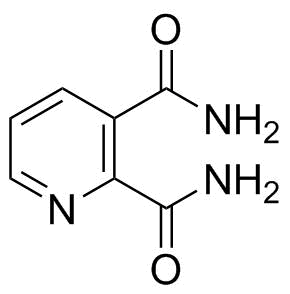 |
| Molecular Formula | C7H7N3O2 |
| Molecular Weight | 165.15 |
| CAS Registry Number | 4663-94-9 |
| EC Number | 679-686-4 |
| SMILES | C1=CC(=C(N=C1)C(=O)N)C(=O)N |
| Density | 1.4±0.1 g/cm3 Calc.* |
|---|---|
| Boiling point | 479.5±30.0 °C 760 mmHg (Calc.)* |
| Flash point | 243.8±24.6 °C (Calc.)* |
| Index of refraction | 1.621 (Calc.)* |
| * | Calculated using Advanced Chemistry Development (ACD/Labs) Software. |
| Hazard Symbols |  GHS07 Warning Details GHS07 Warning Details | ||||||||||||
|---|---|---|---|---|---|---|---|---|---|---|---|---|---|
| Risk Statements | H315-H319 Details | ||||||||||||
| Safety Statements | P264-P264+P265-P280-P302+P352-P305+P351+P338-P321-P332+P317-P337+P317-P362+P364 Details | ||||||||||||
| Hazard Classification | |||||||||||||
| |||||||||||||
| SDS | Available | ||||||||||||
 chemBlink Chemical Story
|
Pyridine-2,3-dicarboxamide is a heterocyclic aromatic dicarboxamide consisting of a pyridine ring substituted with two adjacent carboxamide groups at the 2- and 3-positions. It belongs to the class of pyridine carboxamides and is a nitrogen-containing aromatic compound with multiple hydrogen-bonding functionalities. Structurally, the molecule is built upon a pyridine ring, a six-membered aromatic heterocycle containing one nitrogen atom and five carbon atoms. The ring possesses a delocalized six π-electron system that satisfies the criteria for aromaticity, giving the molecule considerable thermodynamic stability. The ring nitrogen is sp2-hybridized and contributes one electron to the aromatic π-system while retaining a lone pair of electrons in an sp2 orbital. This lone pair is not involved in aromatic delocalization and serves as a hydrogen bond acceptor. At the 2- and 3-positions of the pyridine ring are two carboxamide groups (–C(=O)NH2). Each carboxamide consists of a carbonyl group directly bonded to an amino group. The carbonyl carbon is sp2-hybridized and participates in resonance with the adjacent nitrogen atom, resulting in partial double-bond character of the carbon–nitrogen bond. This resonance restricts rotation around the amide bond and causes each amide group to adopt a nearly planar geometry. The presence of two adjacent amide substituents creates a highly polar region within the molecule. Each carbonyl oxygen functions as a strong hydrogen bond acceptor, while each amide nitrogen can serve as a hydrogen bond donor. Together with the pyridine nitrogen, the molecule contains multiple hydrogen-bonding sites capable of participating in extensive intermolecular and intramolecular interactions. The adjacent arrangement of the two carboxamide groups influences both steric and electronic properties. The proximity of the substituents permits the formation of intramolecular hydrogen bonds under suitable conformations and also affects electron distribution throughout the aromatic ring. The electron-withdrawing nature of the carbonyl groups reduces electron density within the pyridine ring through inductive effects, while resonance interactions are largely localized within each amide functionality. From a structural standpoint, the pyridine ring remains essentially planar because of its aromatic character. The amide groups are typically oriented close to the plane of the aromatic ring to maximize conjugation between the carbonyl groups and the aromatic system, although steric interactions between the neighboring substituents may produce slight deviations from coplanarity. Physicochemically, pyridine-2,3-dicarboxamide is a highly polar compound. The combination of two amide groups and one pyridine nitrogen provides substantial hydrogen-bonding capability, resulting in relatively strong intermolecular association in the solid state. These interactions contribute to high melting points and influence crystal packing. The compound is generally more soluble in polar solvents than in nonpolar solvents because of its multiple hydrogen-bond donor and acceptor sites. The aromatic pyridine ring contributes modest hydrophobic character, but the polarity of the two amide groups dominates the overall molecular behavior. Chemically, the amide groups are relatively stable under neutral conditions because of resonance stabilization of the amide bond. Under strongly acidic or strongly basic conditions, amide hydrolysis can occur to produce the corresponding pyridine dicarboxylic acid and ammonia or ammonium derivatives. The pyridine nitrogen can also undergo protonation in acidic media, forming pyridinium salts without disrupting the aromatic system. The molecule can also function as a ligand in coordination chemistry. The pyridine nitrogen and, in some cases, the carbonyl oxygen atoms may coordinate to suitable metal ions, forming coordination complexes through donation of lone-pair electrons. Overall, pyridine-2,3-dicarboxamide is an aromatic heterocyclic dicarboxamide composed of a pyridine ring bearing two adjacent carboxamide substituents. Its planar aromatic framework, resonance-stabilized amide groups, and multiple hydrogen-bonding sites give the molecule a highly polar character and define its structural and chemical properties. References 2025. Investigation of Development Dynamics of Defects Induced by Electric Field in Polysiloxane Sample. Inorganic Materials: Applied Research. DOI: 10.1134/s2075113325700947 2025. Response of Ni(II) Bonds to Stretching Deformations of Ni(II)-Pyridinedicarboxamide Crystal. Theoretical Foundations of Chemical Engineering. DOI: 10.1134/s0040579525601761 2025. Structural Organization of the Self–Healing Copolymers of Polydimethylsiloxane and Ni(II)pyridinedicarboxamide by the Molecular Dynamics and Fragment Condensation Approach. Journal of Inorganic and Organometallic Polymers and Materials. DOI: 10.1007/s10904-024-03580-9 |
| Market Analysis Reports |