
Online Database of Chemicals from Around the World
| Shanghai Sinofluoro chemicals Co., Ltd. | China | |||
|---|---|---|---|---|
 | www.sinofluoro.com | |||
 | +86 (21) 6427-9360 | |||
 | +86 (21) 6427-8603 | |||
 | simon.lv@sinofluoro.com jerry.chen@sinofluoro.com | |||
 | QQ Chat | |||
| Chemical manufacturer since 2008 | ||||
| chemBlink Standard supplier since 2008 | ||||
| Zhejiang Ausun Pharmaceutical Co., Ltd. | China | |||
|---|---|---|---|---|
| www.ausunpharm.com | |||
| +86 (576) 8558-9335 +86 13957690608 | |||
| +86 (576) 8558-9168 | |||
| sales@ausunpharm.com | |||
| Chemical manufacturer since 2011 | ||||
| chemBlink Standard supplier since 2009 | ||||
| Hangzhou Leap Chem Co., Ltd. | China | |||
|---|---|---|---|---|
| www.leapchem.com | |||
| +86 (571) 8771-1850 | |||
| market19@leapchem.com | |||
| QQ Chat | |||
| Chemical manufacturer since 2006 | ||||
| chemBlink Standard supplier since 2015 | ||||
| Shanghai Yingrui Biopharm Co., Ltd. | China | |||
|---|---|---|---|---|
| www.shyrchem.com | |||
| +86 (21) 3358-5366 3466-6753 +86 13311639313 | |||
| +86 (21) 3497-9012 | |||
| sales02@shyrchem.com | |||
| QQ Chat | |||
 | Skype Chat | |||
| Chemical manufacturer since 2009 | ||||
| chemBlink Standard supplier since 2017 | ||||
| Shanghai Weiyuan Technology Co., Ltd | China | |||
|---|---|---|---|---|
| www.shweiyuan.cn | |||
| +86 13024122785 | |||
| sales@shweiyuan.cn | |||
| QQ Chat | |||
| Chemical manufacturer since 2019 | ||||
| chemBlink Standard supplier since 2021 | ||||
| Prisun Pharmatech Co., Ltd. | China | |||
|---|---|---|---|---|
| www.prisunpharma.com | |||
| +86 (21) 5432-6183 | |||
| prisun@prisunpharma.com | |||
| Chemical manufacturer since 2011 | ||||
| chemBlink Standard supplier since 2021 | ||||
| Shanghai Finetech pharm Co., Ltd. | China | |||
|---|---|---|---|---|
| www.finetechpharm.cn | |||
| +86 18221039705 | |||
| ad@finetechpharm.cn | |||
| Chemical manufacturer since 2016 | ||||
| chemBlink Standard supplier since 2026 | ||||
| Epsilon Chimie Chemical Manufacturer | France | |||
|---|---|---|---|---|
| www.epsilon-chimie.com | |||
| +33 (2) 9842-4650 | |||
| +33 (2) 9842-4402 | |||
| pierre.cornec@epsilon-chimie.com | |||
| Chemical manufacturer | ||||
| Classification | Chemical reagent >> Organic reagent >> Phosphonate / phosphonate |
|---|---|
| Name | Dimethyl (2-oxo-3,3-difluoroheptyl)phosphonate |
| Synonyms | (3,3-Difluoro-2-oxoheptyl)phosphonic acid dimethyl ester; Dimethyl (3,3-difluoro-2-oxoheptyl)phosphonate |
| Molecular Structure | 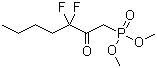 |
| Molecular Formula | C9H17F2O4P |
| Molecular Weight | 258.20 |
| CAS Registry Number | 50889-46-8 |
| SMILES | CCCCC(C(=O)CP(=O)(OC)OC)(F)F |
| Density | 1.2±0.1 g/cm3 Calc.* |
|---|---|
| Boiling point | 301.0±37.0 °C 760 mmHg (Calc.)* |
| Flash point | 135.8±26.5 °C (Calc.)* |
| Index of refraction | 1.405 (Calc.)* |
| * | Calculated using Advanced Chemistry Development (ACD/Labs) Software. |
| Hazard Symbols |  GHS07 Warning Details GHS07 Warning Details |
|---|---|
| Risk Statements | H302-H315-H319-H332-H335 Details |
| Safety Statements | P261-P280-P305+P351+P338 Details |
| SDS | Available |
 chemBlink Chemical Story
|
Dimethyl (2-oxo-3,3-difluoroheptyl)phosphonate is an organophosphorus compound containing a phosphonate ester linked to a fluorinated aliphatic carbonyl chain. Structurally, it consists of a dimethyl phosphonate group attached to a seven-carbon backbone that bears both a ketone at the 2-position and a geminal difluoro substitution at the 3-position. The combination of a phosphonate ester, a carbonyl group, and fluorinated alkyl substituents makes this compound a highly functionalized intermediate in organophosphorus and fluorine chemistry. Phosphonate esters are a well-established class of organophosphorus compounds characterized by a stable carbon–phosphorus (C–P) bond. Unlike phosphate esters, phosphonates contain a direct C–P linkage, which imparts increased chemical stability toward hydrolysis and metabolic degradation. Dimethyl phosphonates, in particular, are widely used in synthetic chemistry as intermediates for the construction of more complex phosphorus-containing molecules, including phosphonic acids and phosphonate-based bioactive compounds. The presence of the 2-oxo (ketone) group introduces a strong electrophilic center within the carbon chain. Ketones are polarized functional groups capable of undergoing nucleophilic addition reactions, and in this molecule the carbonyl carbon is further influenced by adjacent substituents. The proximity of the phosphonate group can affect electronic distribution through inductive effects, subtly modifying the reactivity of the carbonyl functionality. A defining feature of this compound is the 3,3-difluoro substitution on the carbon chain. Geminal difluoro groups are strongly electron-withdrawing due to the high electronegativity of fluorine atoms. This substitution significantly alters the electronic properties of the molecule by stabilizing adjacent partial positive charge and increasing the electrophilicity of nearby functional groups, including the carbonyl carbon. Fluorine substitution also influences lipophilicity, metabolic stability, and conformational behavior of organic molecules. Organofluorine chemistry plays an important role in modern medicinal chemistry and materials science because fluorine incorporation can dramatically change physicochemical properties. In this compound, the difluoro group increases polarity and may enhance resistance to oxidative metabolism, while also affecting the acidity of nearby hydrogen atoms and the overall dipole moment of the molecule. The phosphonate ester group contains two methoxy substituents attached to phosphorus, which are susceptible to hydrolysis under strong acidic or basic conditions. Hydrolysis of dimethyl phosphonates typically yields the corresponding phosphonic acid, which is significantly more polar and often biologically active in related systems. The stability of the phosphonate ester under neutral conditions makes it a useful protected form in synthetic sequences. From a structural standpoint, the molecule is flexible due to the aliphatic carbon chain, but its conformational preferences are influenced by the presence of polar functional groups. The electron-withdrawing difluoromethylene unit can restrict rotation and influence the preferred spatial orientation of substituents, while the carbonyl group introduces planarity at the 2-position. Compounds containing both phosphonate and fluorinated carbonyl motifs are often encountered as intermediates in the synthesis of biologically active molecules, agrochemicals, and enzyme inhibitors. Phosphonate analogues of carboxylic acids are particularly important in biochemical research because they can act as stable mimics of phosphate or carboxylate-containing substrates in enzymatic systems. In terms of physicochemical properties, dimethyl (2-oxo-3,3-difluoroheptyl)phosphonate is expected to exhibit moderate polarity due to the combination of phosphonate, carbonyl, and fluorine substituents. It is likely more soluble in polar organic solvents than in nonpolar hydrocarbons, while remaining less hydrophilic than fully ionized phosphonic acids. Overall, dimethyl (2-oxo-3,3-difluoroheptyl)phosphonate is a multifunctional organophosphorus compound featuring a stable phosphonate ester, a reactive ketone group, and a strongly electron-withdrawing difluorinated carbon center. Its significance lies in its role as a versatile synthetic intermediate in organophosphorus and fluorinated organic chemistry, where its functional group diversity enables further chemical elaboration. References 2009. Lubiprostone. Pharmaceutical Substances. URL: https://pharmaceutical-substances.thieme.com/ps/search-results?docUri=KD-16-0287 |
| Market Analysis Reports |