
Online Database of Chemicals from Around the World
| Changzhou Ditong Chemical Co., Ltd. | China | |||
|---|---|---|---|---|
 | www.edengenechem.com | |||
 | +86 (519) 8829-8848 +86 18118010980 | |||
 | info@edengenechem.com sale@edengenechem.com | |||
 | QQ Chat | |||
 | WeChat: 18118010980 | |||
| Chemical manufacturer since 2006 | ||||
| chemBlink Premium supplier since 2026 | ||||
| Classification | Biochemical >> Amino acids and their derivatives >> Amino alcohol derivative |
|---|---|
| Name | 2-Aminophenethanol |
| Synonyms | 2-(2-Aminophenyl)-ethanol; o-Aminophenethyl alcohol |
| Molecular Structure | 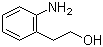 |
| Molecular Formula | C8H11NO |
| Molecular Weight | 137.18 |
| CAS Registry Number | 5339-85-5 |
| EC Number | 226-275-9 |
| SMILES | C1=CC=C(C(=C1)CCO)N |
| Density | 1.1±0.1 g/cm3 Calc.*, 1.045 g/mL (Expl.) |
|---|---|
| Boiling point | 306.7 °C 760 mmHg (Calc.)*, 355.5 - 356.9 °C (Expl.) |
| Flash point | 127.9±20.4 °C (Calc.)* |
| Index of refraction | 1.597 (Calc.)*, 1.588 (Expl.) |
| * | Calculated using Advanced Chemistry Development (ACD/Labs) Software. |
| Hazard Symbols |  GHS07 Warning Details GHS07 Warning Details | ||||||||||||||||||||||||
|---|---|---|---|---|---|---|---|---|---|---|---|---|---|---|---|---|---|---|---|---|---|---|---|---|---|
| Risk Statements | H302-H315-H319-H335 Details | ||||||||||||||||||||||||
| Safety Statements | P261-P264-P264+P265-P270-P271-P280-P301+P317-P302+P352-P304+P340-P305+P351+P338-P319-P321-P330-P332+P317-P337+P317-P362+P364-P403+P233-P405-P501 Details | ||||||||||||||||||||||||
| Hazard Classification | |||||||||||||||||||||||||
| |||||||||||||||||||||||||
| SDS | Available | ||||||||||||||||||||||||
 chemBlink Chemical Story
|
2-Aminophenethanol is an aromatic amino alcohol belonging to the class of substituted phenethylamine derivatives. The compound consists of a benzene ring connected to a two-carbon side chain containing a primary alcohol group and an amino group located at the 2-position of the aromatic ring. Its structure combines the chemical characteristics of an aniline derivative and a primary alcohol, making it a useful intermediate in organic synthesis and chemical research. The development of aromatic amino alcohol chemistry is closely related to the broader study of phenethylamine derivatives and substituted aromatic compounds. Phenethylamine structures have been investigated extensively because they provide versatile frameworks for the synthesis of molecules containing both aromatic and aliphatic functional groups. Methods for preparing substituted phenethylamines and amino alcohols have been developed as part of advances in synthetic organic chemistry. The molecular structure of 2-aminophenethanol contains a benzene ring bearing an amino substituent and a hydroxyethyl side chain. The aromatic ring is a planar structure with a delocalized pi-electron system. The amino group attached to the ring is an aniline-type amino group, while the hydroxyethyl side chain contains a primary alcohol functionality. The amino group is an important reactive site in the molecule. The nitrogen atom contains a lone pair of electrons and can participate in protonation reactions, forming ammonium salts with acids. It can also undergo common amine transformations, including acylation and alkylation reactions. Because the amino group is directly attached to the aromatic ring, its electronic properties differ from those of aliphatic amines. The hydroxyl group of the ethanol side chain contributes significant polarity to the molecule. The oxygen atom of the alcohol contains lone pairs and can act as a hydrogen bond acceptor, while the hydroxyl hydrogen can act as a hydrogen bond donor. These interactions influence the compound's solubility and behavior in polar solvents. The combination of amino and hydroxyl functionalities gives 2-aminophenethanol a bifunctional structure. Both functional groups can participate in chemical transformations, allowing the compound to serve as a starting material for the synthesis of more complex organic molecules. The relative positions of the aromatic amino group and hydroxyethyl group provide opportunities for selective modification. The compound has been used primarily as an intermediate in organic synthesis. Aromatic amino alcohols are valuable building blocks because they contain two reactive functional groups that can be independently modified. They are used in the preparation of heterocyclic compounds, pharmaceutical intermediates, and other specialty chemicals. In pharmaceutical chemistry, amino alcohol structures are common motifs found in many biologically active molecules. Researchers use substituted amino alcohols as intermediates because the amino and hydroxyl groups can be transformed into different functional groups during multi-step synthesis. The aromatic ring also provides a stable framework for molecular modification. The amino alcohol framework is also relevant to heterocyclic chemistry. Compounds containing neighboring amino and hydroxyl groups can participate in cyclization reactions to form nitrogen- and oxygen-containing heterocycles under appropriate synthetic conditions. These heterocyclic structures are important components in many areas of chemical research. The physical and chemical properties of 2-aminophenethanol are influenced by the balance between its aromatic ring and polar functional groups. The benzene ring contributes hydrophobic character, while the amino and hydroxyl groups increase polarity and enable hydrogen bonding. This combination gives the molecule properties typical of aromatic amino alcohols. The compound also serves as an example of how functional group arrangement affects molecular behavior. The presence of an aromatic amino group and an aliphatic alcohol in the same molecule allows chemists to explore interactions between different chemical environments and to design derivatives with modified properties. Overall, 2-aminophenethanol is a functionalized aromatic amino alcohol whose importance lies mainly in its role as a synthetic intermediate. Its combination of an aniline amino group, primary alcohol functionality, and aromatic framework makes it a versatile building block for organic synthesis, pharmaceutical research, and the preparation of more complex chemical structures. References 2026. Catalyst-Assisted Synthesis of Benzimidazole Derivatives: Recent Advances and Mechanistic Insights. Topics in current chemistry (Cham). DOI: 10.1007/s41061-025-00535-7 2025. Recent Developments in Borrowing Hydrogen Methodology in N-alkylation of Amines. Topics in current chemistry (Cham). DOI: 10.1007/s41061-025-00523-x 2020. Enzymatic Synthesis of a Conducting Aniline and 2-aminophenethyl Alcohol Copolymer with Functional Groups. Applied Biochemistry and Microbiology. DOI: 10.1134/s0003683820040080 |
| Market Analysis Reports |