
Online Database of Chemicals from Around the World
| AAT Bioquest, Inc. | USA | |||
|---|---|---|---|---|
 | www.aatbio.com | |||
 | +1 (408) 733-1055 | |||
 | +1 (408) 733-1304 | |||
 | jack@aatbio.com | |||
| Chemical manufacturer since 2005 | ||||
| chemBlink Standard supplier since 2010 | ||||
| Xuzhou Xbetop Biotechnology Co., Ltd. | China | |||
|---|---|---|---|---|
| www.xbetop.com | |||
| +86 (516) 8329-1698 | |||
| +86 (516) 8329-1698 | |||
| xbetop@gmail.com xbetop@hotmail.com | |||
 | QQ Chat | |||
| Chemical manufacturer | ||||
| chemBlink Standard supplier since 2011 | ||||
| SRI Neelima Laboratories | India | |||
|---|---|---|---|---|
| www.srineelimalaboratories.com | |||
| +91 (984) 973-6989 | |||
| sales@srineelimalaboratories.com | |||
| Chemical manufacturer | ||||
| chemBlink Standard supplier since 2011 | ||||
| HuNan Huibaiyi New Materials Co; Ltd. | China | |||
|---|---|---|---|---|
| www.hbsjxcl.com | |||
| +86 13319523173 | |||
| ivy@hnhbsj.com | |||
| QQ Chat | |||
 | WeChat: 13319523173 | |||
| Chemical manufacturer since 2014 | ||||
| chemBlink Standard supplier since 2026 | ||||
| Chemos GmbH & Co. KG | Germany | |||
|---|---|---|---|---|
| www.chemos.de | |||
| +49 871-966346-0 | |||
| +49 871-966346-13 | |||
| chemos@chemos.de | |||
| Chemical distributor | ||||
| Real-Times (Beijing) Biotechnology Co., Ltd. | China | |||
|---|---|---|---|---|
| www.real-times.com.cn | |||
| +86 (10) 8259-8075 +86 13426307855 | |||
| +86 (10) 8259-7807 | |||
| real-times@163.com | |||
| Chemical manufacturer since 2006 | ||||
| Indofine Chemical Company, Inc. | USA | |||
|---|---|---|---|---|
| www.indofinechemical.com | |||
| +1 (888) 463-6346 | |||
| +1 (908) 359-1179 | |||
| info@indofinechemical.com | |||
| Chemical manufacturer since 1981 | ||||
| SBS Genetech Co., Ltd. | China | |||
|---|---|---|---|---|
| www.sbsbio.com | |||
| +86 (10) 8278-4296 8278-4292 6296-9345 | |||
| +86 (10) 8278-4290 | |||
| info@sbsbio.com | |||
| Chemical manufacturer | ||||
| Melford Laboratories Limited | UK | |||
|---|---|---|---|---|
| www.melford.co.uk | |||
| +44 (1449) 741-178 | |||
| +44 (1449) 741-217 | |||
| pfranklin@melford.co.uk sales@melford.co.uk | |||
| Chemical manufacturer since 1985 | ||||
| Classification | Biochemical >> Carbohydrate >> Monosaccharide |
|---|---|
| Name | 4-Methylumbelliferyl beta-D-galactoside |
| Synonyms | 4-Methylumbelliferyl-beta-D-galactopyranoside; 7-(beta-D-Galactopyranosyloxy)-4-methyl-2H-1-benzopyran-2-one |
| Molecular Structure | 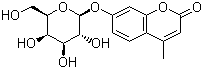 |
| Molecular Formula | C16H18O8 |
| Molecular Weight | 338.31 |
| CAS Registry Number | 6160-78-7 |
| EC Number | 228-185-5 |
| SMILES | CC1=CC(=O)OC2=C1C=CC(=C2)O[C@H]3[C@@H]([C@H]([C@H]([C@H](O3)CO)O)O)O |
| Density | 1.5±0.1 g/cm3 Calc.* |
|---|---|
| Melting point | 260 °C (Decomposes) (Expl.) |
| Boiling point | 626.9±55.0 °C 760 mmHg (Calc.)* |
| Flash point | 233.9±25.0 °C (Calc.)* |
| Solubility | water: soluble (Expl.) |
| Index of refraction | 1.641 (Calc.)* |
| Alpha | -64 ° (c=1, pyridine, after) (Expl.) |
| * | Calculated using Advanced Chemistry Development (ACD/Labs) Software. |
| Hazard Symbols |  GHS07 Warning Details GHS07 Warning Details | ||||||||||||||||
|---|---|---|---|---|---|---|---|---|---|---|---|---|---|---|---|---|---|
| Risk Statements | H315-H319-H335 Details | ||||||||||||||||
| Safety Statements | P261-P264-P264+P265-P271-P280-P302+P352-P304+P340-P305+P351+P338-P319-P321-P332+P317-P337+P317-P362+P364-P403+P233-P405-P501 Details | ||||||||||||||||
| Hazard Classification | |||||||||||||||||
| |||||||||||||||||
| SDS | Available | ||||||||||||||||
 chemBlink Chemical Story
|
4-Methylumbelliferyl β-D-galactoside is a synthetic fluorogenic glycoside used as a substrate for detecting β-galactosidase enzyme activity in biochemical and molecular biology assays. It consists of a β-D-galactopyranose sugar linked through a glycosidic bond to a 4-methylumbelliferone aglycone. The compound is designed so that enzymatic cleavage produces a strongly fluorescent product. Structurally, the molecule contains a β-D-galactopyranose unit, which is a six-membered sugar ring derived from D-galactose. The ring adopts a stable chair conformation and contains multiple hydroxyl groups arranged in defined stereochemistry. These hydroxyl groups contribute significant polarity and hydrogen-bonding capability, making the glycoside highly compatible with aqueous biological environments. The glycosidic linkage is a β-linkage, meaning the substituent attached to the anomeric carbon (C1) of the sugar is oriented in the same configuration as the C5 substituent of D-galactose. This stereochemical configuration is essential for recognition and hydrolysis by β-galactosidase enzymes, which specifically catalyze cleavage of β-linked galactosides. The aglycone portion is 4-methylumbelliferone, a coumarin derivative consisting of a fused benzene and α-pyrone ring system. This bicyclic lactone structure is highly conjugated and planar, enabling strong absorption and fluorescence properties once released from the sugar moiety. The methyl substituent at the 4-position of the coumarin ring modifies electronic distribution and slightly shifts its photophysical characteristics. In the intact glycoside, the phenolic oxygen of 4-methylumbelliferone is linked to the sugar via an ether bond, which suppresses fluorescence. This is because glycosylation disrupts the electronic structure required for efficient excitation and emission. Upon enzymatic hydrolysis by β-galactosidase, the glycosidic bond is cleaved, releasing free 4-methylumbelliferone and D-galactose. The liberated aglycone regains its extended conjugation and aromatic–lactone resonance stabilization, enabling strong fluorescence under ultraviolet excitation. The fluorescence of 4-methylumbelliferone is pH-dependent. Under alkaline conditions, deprotonation of the phenolic hydroxyl group enhances electron delocalization across the coumarin system, resulting in increased fluorescence intensity. This property is commonly exploited in quantitative enzymatic assays. From a physicochemical perspective, 4-methylumbelliferyl β-D-galactoside is highly polar due to the multiple hydroxyl groups of the sugar moiety. It is readily soluble in aqueous buffers used in enzymatic assays. The coumarin portion contributes moderate hydrophobicity and is responsible for the optical properties of the molecule after hydrolysis. The compound is chemically stable under neutral conditions but specifically susceptible to enzymatic cleavage of the β-glycosidic bond. The lactone ring of the coumarin aglycone remains intact during enzymatic hydrolysis and is essential for fluorescence generation. The sugar portion primarily governs solubility and enzyme recognition, while the coumarin portion functions as a latent fluorophore. This separation of roles between recognition element and signal-generating element is a common design principle in fluorogenic enzyme substrates. Overall, 4-methylumbelliferyl β-D-galactoside is a synthetic β-galactoside composed of a galactose-derived sugar linked to a coumarin-based fluorophore. Its structure enables selective enzymatic hydrolysis by β-galactosidase, producing a fluorescent signal used widely in biochemical and molecular biology applications. References 2023. Multimodal action of KRP203 on phosphoinositide kinases in vitro and in cells. Biochemical and Biophysical Research Communications. DOI: 10.1016/j.bbrc.2023.08.050 2022. A quantitative high-throughput screen identifies compounds that lower expression of the SCA2-and ALS-associated gene ATXN2. The Journal of biological chemistry. DOI: 10.1016/j.jbc.2022.102228 2020. Non-targeted detection and differentiation of agonists versus antagonists, directly in bioprofiles of everyday products. Analytica Chimica Acta. DOI: 10.1016/j.aca.2020.05.057 |
| Market Analysis Reports |