
Online Database of Chemicals from Around the World
| BOC Sciences | USA | |||
|---|---|---|---|---|
 | www.bocsci.com | |||
 | +1 (631) 485-4226 | |||
 | +1 (631) 614-7828 | |||
 | info@bocsci.com | |||
| Chemical manufacturer | ||||
| chemBlink Standard supplier since 2010 | ||||
| Hubei xindesheng Material Technology Co., Ltd | China | |||
|---|---|---|---|---|
| www.deshengivd.com | |||
| +86 18971041571 | |||
| zjing@gmail.com | |||
 | QQ Chat | |||
| Chemical manufacturer since 2017 | ||||
| chemBlink Standard supplier since 2021 | ||||
| HuNan Huibaiyi New Materials Co; Ltd. | China | |||
|---|---|---|---|---|
| www.hbsjxcl.com | |||
| +86 13319523173 | |||
| ivy@hnhbsj.com | |||
| QQ Chat | |||
 | WeChat: 13319523173 | |||
| Chemical manufacturer since 2014 | ||||
| chemBlink Standard supplier since 2026 | ||||
| GenScript Corporation | USA | |||
|---|---|---|---|---|
| www.genscript.com | |||
| +1 (732) 885-9188 | |||
| +1 (732) 210-0262 | |||
| order@genscript.com | |||
| Chemical manufacturer | ||||
| Dojindo Molecular Technologies, Inc. | USA | |||
|---|---|---|---|---|
| www.dojindo.com | |||
| +1 (301) 987-2667 | |||
| +1 (301) 987-2687 | |||
| info@dojindo.com | |||
| Chemical manufacturer | ||||
| OChem Incorporation | USA | |||
|---|---|---|---|---|
| www.ocheminc.com | |||
| +1 (847) 403-7044 | |||
| +1 (847) 298-5008 | |||
| sales@ocheminc.com | |||
| Chemical manufacturer | ||||
| Classification | Biochemical >> Biochemical reagent >> Biological dye |
|---|---|
| Name | N-Ethyl-N-(2-hydroxy-3-sulfopropyl)-3,5-dimethylaniline sodium salt monohydrate |
| Synonyms | MAOS |
| Molecular Structure | 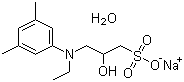 |
| Molecular Formula | C13H20NNaO4S.H2O |
| Molecular Weight | 327.37 |
| CAS Registry Number | 82692-97-5 |
| SMILES | CCN(CC(CS(=O)(=O)[O-])O)C1=CC(=CC(=C1)C)C.[Na+] |
| Hazard Symbols |  GHS07 Warning Details GHS07 Warning Details |
|---|---|
| Risk Statements | H302-H315-H319 Details |
| Safety Statements | P501-P270-P264-P280-P302+P352-P337+P313-P305+P351+P338-P362+P364-P332+P313-P301+P312+P330 Details |
| SDS | Available |
 chemBlink Chemical Story
|
N-Ethyl-N-(2-hydroxy-3-sulfopropyl)-3,5-dimethylaniline sodium salt monohydrate is a water-soluble aromatic amine sulfonate commonly used as a coupling reagent or electron-rich chromogenic component in biochemical colorimetric assays, especially in peroxidase-based detection systems. Structurally, the compound is based on a substituted aniline core, consisting of a benzene ring bearing two methyl groups at the 3 and 5 positions and a dialkylated amino group attached to the ring nitrogen. The aromatic ring provides a conjugated π-electron system, while the methyl substituents increase electron density through inductive effects and contribute steric bulk that influences molecular conformation and reactivity. The nitrogen atom of the aniline core is substituted with an ethyl group and a 2-hydroxy-3-sulfopropyl chain, forming a tertiary amine. This substitution prevents proton donation from the nitrogen while maintaining its ability to participate in electron-donating resonance interactions with the aromatic ring when unprotonated. The dialkylated amine is strongly electron-donating, which activates the aromatic system toward oxidative coupling reactions. The 2-hydroxy-3-sulfopropyl substituent introduces both hydroxyl and sulfonate functionalities. The sulfonate group is strongly acidic and exists in its deprotonated form as a sulfonate anion under physiological conditions. In the sodium salt form, this negative charge is balanced by sodium cations, which enhance water solubility and ionic stability. The hydroxyl group contributes additional hydrogen-bonding capability and increases polarity. The propyl linker between the nitrogen and sulfonate group provides flexibility, allowing the charged and neutral portions of the molecule to adopt multiple conformations in solution. This flexibility reduces steric constraints and improves solubility in aqueous systems. From an electronic perspective, the compound contains a strongly electron-rich aromatic system due to the presence of the dialkylamino substituent and methyl groups. The nitrogen lone pair can delocalize into the aromatic ring through resonance, increasing electron density at the ortho and para positions. This electronic activation makes the molecule particularly reactive toward electrophilic oxidation, which is central to its function in color-forming reactions. In enzymatic assay systems, compounds of this class often participate in oxidative coupling reactions mediated by enzymes such as peroxidases in the presence of hydrogen peroxide. The electron-rich aromatic ring can be oxidized to form radical intermediates, which then couple with other chromogenic partners to generate colored products. These reactions produce highly conjugated structures responsible for visible absorbance. Physicochemically, N-Ethyl-N-(2-hydroxy-3-sulfopropyl)-3,5-dimethylaniline sodium salt monohydrate is highly polar and water soluble due to its sulfonate group and ionic sodium counterion. The aromatic portion provides moderate hydrophobic character, but the overall molecule behaves as an ionic organic salt in aqueous solution. The monohydrate form indicates the presence of one water molecule integrated into the crystal lattice. This water participates in hydrogen bonding with sulfonate oxygen atoms and hydroxyl groups, contributing to crystal stability and influencing solid-state properties such as melting point and solubility. Chemically, the most reactive site is the electron-rich aromatic ring, which undergoes oxidation under enzymatic or chemical oxidizing conditions. The tertiary amine substituent also influences redox behavior by stabilizing cationic intermediates formed during oxidation. The sulfonate group itself is chemically stable and serves primarily as a solubilizing and charge-stabilizing functionality. It does not participate directly in redox reactions but plays a key role in maintaining aqueous compatibility and ionic strength in assay environments. Overall, N-Ethyl-N-(2-hydroxy-3-sulfopropyl)-3,5-dimethylaniline sodium salt monohydrate is a highly water-soluble, electron-rich aromatic amine derivative featuring a dialkylated aniline core linked to a sulfonated hydroxypropyl side chain. Its combination of strong electron donation, ionic functionality, and oxidative reactivity makes it useful in colorimetric and enzymatic detection systems in biochemical applications. |
| Market Analysis Reports |