
Online Database of Chemicals from Around the World
| BOC Sciences | USA | |||
|---|---|---|---|---|
 | www.bocsci.com | |||
 | +1 (631) 485-4226 | |||
 | +1 (631) 614-7828 | |||
 | info@bocsci.com | |||
| Chemical manufacturer | ||||
| chemBlink Standard supplier since 2010 | ||||
| Hangzhou Leap Chem Co., Ltd. | China | |||
|---|---|---|---|---|
| www.leapchem.com | |||
| +86 (571) 8771-1850 | |||
| market19@leapchem.com | |||
 | QQ Chat | |||
| Chemical manufacturer since 2006 | ||||
| chemBlink Standard supplier since 2015 | ||||
| Shanghai Yingrui Biopharm Co., Ltd. | China | |||
|---|---|---|---|---|
| www.shyrchem.com | |||
| +86 (21) 3358-5366 3466-6753 +86 13311639313 | |||
| +86 (21) 3497-9012 | |||
| sales02@shyrchem.com | |||
| QQ Chat | |||
 | Skype Chat | |||
| Chemical manufacturer since 2009 | ||||
| chemBlink Standard supplier since 2017 | ||||
| Ningbo Kilo Biotechnology Co., Ltd. | China | |||
|---|---|---|---|---|
| www.kilobio.com | |||
| +8613989352104 | |||
| terry.zhang@kilobio.com | |||
| QQ Chat | |||
 | WeChat: Wenzhou Medical University | |||
| Chemical distributor since 2023 | ||||
| chemBlink Standard supplier since 2023 | ||||
| Classification | API >> Special medicine >> Ophthalmic medication |
|---|---|
| Name | Latanoprostene bunod |
| Synonyms | (5Z)-7-[(1R,2R,3R,5S)-3,5-Dihydroxy-2-[(3R)-3-hydroxy-5-phenylpentyl]cyclopentyl]-5-heptenoic acid 4-(nitrooxy)butyl ester; NCX 116 |
| Molecular Structure | 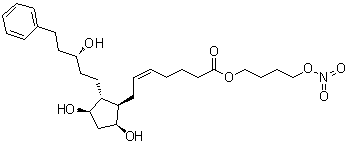 |
| Molecular Formula | C27H41NO8 |
| Molecular Weight | 507.62 |
| CAS Registry Number | 860005-21-6 |
| EC Number | 817-283-9 |
| SMILES | C1[C@H]([C@@H]([C@H]([C@H]1O)C/C=CCCCC(=O)OCCCCO[N+](=O)[O-])CC[C@H](CCC2=CC=CC=C2)O)O |
| Solubility | Insoluble (1.1E-3 g/L) (25 °C), Calc.* |
|---|---|
| Density | 1.178±0.06 g/cm3 (20 °C 760 Torr), Calc.* |
| Boiling point | 658.3±55.0 °C 760 mmHg (Calc.)* |
| Flash point | 351.9±31.5 °C (Calc.)* |
| Index of refraction | 1.544 (Calc.)* |
| * | Calculated using Advanced Chemistry Development (ACD/Labs) Software. |
| Hazard Symbols |   GHS02;GHS08 Danger Details | ||||||||||||
|---|---|---|---|---|---|---|---|---|---|---|---|---|---|
| Risk Statements | H242-H361 Details | ||||||||||||
| Safety Statements | P203-P210-P234-P235-P240-P280-P318-P370+P378-P403-P405-P410-P411-P420-P501 Details | ||||||||||||
| Hazard Classification | |||||||||||||
| |||||||||||||
 chemBlink Chemical Story
|
Latanoprostene bunod was designed to combine two pharmacological ideas in one molecule. It is an ester that contains the latanoprost acid portion and a nitrate-bearing fragment joined through the carboxyl group. It is distinct from latanoprost, which has a different ester group, and from latanoprost acid itself. The end group therefore conveys something about what can happen after administration, not merely a different spelling of the same compound. The prescribing information describes conversion of the parent molecule to latanoprost acid and butanediol mononitrate. The latter can undergo further metabolism that releases nitric oxide. An organic nitrate group is not free nitric oxide waiting inside a bottle. Its role depends on the transformations that occur after exposure. Separating the parent, the first metabolites, and the subsequent signal makes it possible to discuss the design without assigning each effect directly to the intact ester. Pressure inside the eye depends in part on production and drainage of aqueous humor. More than one drainage pathway contributes. The prostaglandin-related metabolite is associated with increased outflow, including through the uveoscleral route. Nitric oxide signaling is associated with relaxation in structures involved in conventional drainage through the trabecular meshwork and Schlemm's canal. The proposed roles explain why two active components were of interest. An observed change in overall pressure, however, does not by itself measure the contribution of each pathway separately. A pooled report from the APOLLO and LUNAR trials compared the evaluated formulation with timolol in people with open-angle glaucoma or ocular hypertension. Pressure was measured at several times of day. The report found lower pressures with latanoprostene bunod at the assessed points during the controlled comparison. That observation relates to a particular comparator and schedule. It is not a direct comparison with every other pressure-lowering drug, and it is not a direct measurement of the rate of drainage through either pathway. Time of measurement matters because intraocular pressure is not necessarily constant throughout a day. A result at one appointment and a series of observations made at specified times answer related but different questions. A protocol that compares pressures across times provides more information about the observed response than a single reading alone. It also shows why a percentage change quoted without its time point or baseline can conceal important features of the experiment. The nitrate-bearing portion makes this a useful case for distinguishing an active substance from an active signal. The nitrate ester is a covalent feature of the drug structure. Release of nitric oxide involves metabolism, and the signal can act locally before disappearing. Detecting a precursor does not amount to detecting the transient signal itself. The explanation for a finished product can therefore include multiple chemical species even though the drug label names one starting molecule. Careful terminology makes the intended conversion clear without implying that any nitric oxide donor would be interchangeable with this particular ester. The U.S. Vyzulta label documents use to reduce elevated intraocular pressure in open-angle glaucoma or ocular hypertension. This is evidence for a defined formulation, not for all nitrate esters or all prostaglandin-related substances. The chemical interest lies in using one bond to couple two precursor parts that can act after conversion. The clinical question is whether the complete evaluated product produces a useful pressure response; it cannot be answered merely by drawing plausible products of hydrolysis. References: 1. FDA. Vyzulta pharmacology review, NDA 207795. https://www.accessdata.fda.gov/drugsatfda_docs/nda/2017/207795Orig1s000PharmR.pdf 2. DailyMed. VYZULTA prescribing information. https://dailymed.nlm.nih.gov/dailymed/drugInfo.cfm?setid=60ce7900-a677-4fc2-88d0-1603baa9dbd4 3. Pooled APOLLO and LUNAR phase 3 findings. https://pubmed.ncbi.nlm.nih.gov/29194198/ |
| Market Analysis Reports |