
Online Database of Chemicals from Around the World
| Taizhou Crene Biotechnology Co., Ltd. | China | |||
|---|---|---|---|---|
 | www.pharm-intermediates.com | |||
 | +86 (576) 8881-3233 8820-5808 +86 13396860566 | |||
 | +86 (576) 8822-9589 | |||
 | sales@pharm-intermediates.com | |||
 | QQ Chat | |||
| Chemical manufacturer since 2011 | ||||
| chemBlink Standard supplier since 2009 | ||||
| Alfa Chemistry | USA | |||
|---|---|---|---|---|
| www.alfa-chemistry.com | |||
| +1 (516) 734-6573 | |||
| +1 (516) 927-0118 | |||
| support@alfa-chemistry.com | |||
| Chemical manufacturer since 2005 | ||||
| chemBlink Standard supplier since 2012 | ||||
| Shanghai Genriver Pharmaceutical Co., Ltd. | China | |||
|---|---|---|---|---|
| www.genriverpharm.com | |||
| +86 13761582449 +86 13482015261 | |||
| +86 (21) 3778-2903 | |||
| info@genriverpharm.com | |||
| QQ Chat | |||
| Chemical manufacturer since 2016 | ||||
| chemBlink Standard supplier since 2017 | ||||
| Shanghai Forever Synthesis Co.,Ltd. | China | |||
|---|---|---|---|---|
| www.foreversyn.com | |||
| +86 (551) 6288-8437 +86 18096409024 | |||
| sales@foreversyn.com sales02@foreversyn.com | |||
| QQ Chat | |||
 | Skype Chat | |||
| Chemical distributor since 2013 | ||||
| chemBlink Standard supplier since 2018 | ||||
| Shanghai Finetech pharm Co., Ltd. | China | |||
|---|---|---|---|---|
| www.finetechpharm.cn | |||
| +86 18221039705 | |||
| ad@finetechpharm.cn | |||
| Chemical manufacturer since 2016 | ||||
| chemBlink Standard supplier since 2026 | ||||
| Dalton Pharma Services | Canada | |||
|---|---|---|---|---|
| www.dalton.com | |||
| +1 (416) 661-2102 | |||
| +1 (416) 661-2108 | |||
| chemist@dalton.com | |||
| Chemical manufacturer | ||||
| Classification | API >> Other chemicals |
|---|---|
| Name | trans-Latanoprost |
| Synonyms | propan-2-yl (E)-7-[(1R,2R,3R,5S)-3,5-dihydroxy-2-[(3R)-3-hydroxy-5-phenylpentyl]cyclopentyl]hept-5-enoate |
| Molecular Structure | 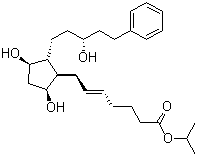 |
| Molecular Formula | C26H40O5 |
| Molecular Weight | 432.59 |
| CAS Registry Number | 913258-34-1 |
| EC Number | 682-020-5 |
| SMILES | CC(C)OC(=O)CCC/C=C/C[C@H]1[C@H](C[C@H]([C@@H]1CC[C@H](CCC2=CC=CC=C2)O)O)O |
| Density | 1.1±0.1 g/cm3 Calc.* |
|---|---|
| Boiling point | 583.8±50.0 °C 760 mmHg (Calc.)* |
| Flash point | 188.3±23.6 °C (Calc.)* |
| Index of refraction | 1.538 (Calc.)* |
| * | Calculated using Advanced Chemistry Development (ACD/Labs) Software. |
| Hazard Symbols |   GHS06;GHS08 Danger Details GHS06;GHS08 Danger Details | ||||||||||||
|---|---|---|---|---|---|---|---|---|---|---|---|---|---|
| Risk Statements | H301-H361 Details | ||||||||||||
| Safety Statements | P203-P264-P270-P280-P301+P316-P318-P321-P330-P405-P501 Details | ||||||||||||
| Hazard Classification | |||||||||||||
| |||||||||||||
| SDS | Available | ||||||||||||
 chemBlink Chemical Story
|
trans-Latanoprost is a stereochemically defined prostaglandin F2α (PGF2α) analogue used primarily in ophthalmology for the reduction of elevated intraocular pressure in conditions such as open-angle glaucoma and ocular hypertension. It is one of the most widely used prostaglandin analog medications due to its strong efficacy and once-daily dosing profile. Latanoprost belongs to the prostanoid class of compounds, which are lipid mediators derived from arachidonic acid. Endogenous prostaglandin F2α regulates smooth muscle tone and various physiological processes through activation of prostanoid FP receptors, a subtype of G protein–coupled receptors. Latanoprost is designed to mimic this natural ligand while improving pharmacokinetic stability and ocular penetration. The “trans” designation refers to the configuration of specific double bonds within the molecule’s side chain, which is critical for its three-dimensional shape and receptor-binding properties. Prostanoid analogues are highly stereospecific, and even small changes in double bond geometry or chiral centers can significantly alter biological activity. The trans configuration in latanoprost contributes to its optimal fit within the FP receptor binding pocket. Latanoprost is administered as an isopropyl ester prodrug. This esterification increases lipophilicity, allowing the molecule to efficiently penetrate the corneal epithelium following topical ocular administration. Once inside the eye, esterases hydrolyze latanoprost into its biologically active form, latanoprost acid. This active metabolite binds FP receptors and produces the therapeutic effect. The primary pharmacological action of latanoprost is increased uveoscleral outflow of aqueous humor. By remodeling extracellular matrix components in the ciliary muscle and enhancing fluid drainage through unconventional outflow pathways, it reduces intraocular pressure. This mechanism differs from drugs that decrease aqueous humor production, making prostaglandin analogues particularly effective in glaucoma management. At the molecular level, FP receptor activation by latanoprost acid triggers intracellular signaling pathways involving phospholipase C, increased intracellular calcium, and downstream changes in gene expression. These signaling events contribute to long-term structural changes in the outflow pathways, which underlie the sustained pressure-lowering effect. Compared with endogenous prostaglandin F2α, latanoprost has been chemically optimized for increased stability and receptor selectivity. Its lipid-like structure enhances corneal permeability, while the prodrug ester form ensures efficient activation in ocular tissues. These modifications allow it to achieve prolonged local activity with minimal systemic exposure. Clinically, latanoprost is typically administered once daily in the evening, as this timing aligns with circadian variations in intraocular pressure and may improve efficacy. It is generally well tolerated, though common side effects include conjunctival hyperemia, eyelash growth (hypertrichosis), and increased iris pigmentation due to long-term melanocyte stimulation. In the context of prostaglandin-based therapeutics, latanoprost is closely related to other agents such as bimatoprost and travoprost, which share similar mechanisms of increasing aqueous humor outflow through FP receptor activation but differ in structural modifications and receptor interactions. Overall, trans-latanoprost is a stereochemically optimized prostaglandin F2α analogue that acts as an FP receptor agonist after conversion to latanoprost acid. Its significance lies in its potent, sustained reduction of intraocular pressure and its central role in modern glaucoma therapy. |
| Market Analysis Reports |