
Online Database of Chemicals from Around the World
| Puyang Yintai Industrial Trading Co., Ltd. | China | |||
|---|---|---|---|---|
 | www.yintai-cn.com | |||
 | +86 (393) 686-7799 443-9615 443-9715 | |||
 | +86 (393) 443-9815 / 638-3299 | |||
 | admin@puyangyintai.com | |||
| Chemical manufacturer | ||||
| chemBlink Standard supplier since 2007 | ||||
| Simagchem Corporation | China | |||
|---|---|---|---|---|
| www.simagchem.com | |||
| +86 13806087780 | |||
| +86 (592) 268-0237 | |||
| sale@simagchem.com | |||
| Chemical manufacturer since 2002 | ||||
| chemBlink Standard supplier since 2008 | ||||
| Hefei TNJ Chemical Industry Co., Ltd. | China | |||
|---|---|---|---|---|
| www.tnjchem.com | |||
| +86 (551) 6541-8684 | |||
| +86 (551) 6541-8697 | |||
| sales@tnjchem.com | |||
| Chemical manufacturer since 2001 | ||||
| chemBlink Standard supplier since 2010 | ||||
| The Dow Chemical Company | USA | |||
|---|---|---|---|---|
| www.dow.com | |||
| +1 (989) 633-1706 | |||
| fmdcigs@dow.com | |||
| Chemical manufacturer | ||||
| chemBlink Standard supplier since 2012 | ||||
| Carbosynth China Ltd. | China | |||
|---|---|---|---|---|
| www.carbosynth.cn | |||
| +86 (512) 6260-5585 | |||
| +86 (512) 6260-5576 | |||
| sales@carbosynth.com | |||
 | QQ Chat | |||
| Chemical manufacturer since 2006 | ||||
| chemBlink Standard supplier since 2016 | ||||
| Anxin Cellulose Co., Ltd. | China | |||
|---|---|---|---|---|
| www.ihpmc.com | |||
| +86 15269329906 | |||
| sales@ihpmc.com | |||
 | WeChat: +86 15269329906 | |||
 | WhatsApp:+8615269329906 | |||
| Chemical manufacturer since 2022 | ||||
| chemBlink Standard supplier since 2022 | ||||
| Riverland Trading LLC. | USA | |||
|---|---|---|---|---|
| www.riverlandtrading.com | |||
| +1 (336).944-2293 | |||
| bens@riverlandtrading.com | |||
| Chemical distributor | ||||
| chemBlink Standard supplier since 2023 | ||||
| Celotech Ruico | China | |||
|---|---|---|---|---|
| celotechruico.com | |||
| +86 (512) 66315208 | |||
| 33445ning@gmail.com | |||
| Chemical manufacturer since 2012 | ||||
| chemBlink Standard supplier since 2026 | ||||
| Celotech | China | |||
|---|---|---|---|---|
| www.celotech.com | |||
| +86 (512) 66315208 | |||
| ce@celotech.com | |||
| Chemical manufacturer since 2005 | ||||
| chemBlink Standard supplier since 2026 | ||||
| Cangzhou Bohai New District Anxin Chemistry Co., Ltd. | China | |||
|---|---|---|---|---|
| www.hpmcproducer.com | |||
| +86 15269348310 | |||
| +86 (317) 555-3727 | |||
| sales@ihpmc.com | |||
| WeChat: +86-152-69348310 | |||
| WhatsApp:+86-152-69348310 | |||
| Chemical manufacturer since 2020 | ||||
| Classification | Biochemical >> Carbohydrate >> Polysaccharide |
|---|---|
| Name | Methyl 2-hydroxyethyl cellulose |
| Synonyms | Tylose® MH 300 |
| Molecular Structure | 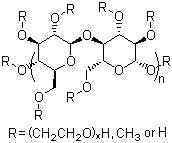 |
| CAS Registry Number | 9032-42-2 |
| EC Number | 618-528-0 |
| SMILES | O3[C@H]([C@@H]([C@H]([C@@H]([C@H]3COC)OC)OC)OC)O[C@@H]4[C@H](O[C@H]([C@@H]([C@H]4OC)OC)OC)COC.O1[C@H]([C@@H]([C@H]([C@@H]([C@H]1CO)O)O)O)O[C@@H]2[C@H](O[C@H]([C@@H]([C@H]2O)O)O)CO.OCCO |
| Density | 1.1 - 1.5 g/mL (20 °C) (Expl.) |
|---|---|
| Solubility | H2O: soluble 20 mg/mL (Expl.) |
| SDS | Available |
|---|---|
 chemBlink Chemical Story
|
Methyl 2-hydroxyethyl cellulose is a chemically modified cellulose derivative belonging to the class of nonionic cellulose ethers. It is produced through partial substitution of the hydroxyl groups present on the cellulose backbone with methyl and 2-hydroxyethyl groups. The degree and distribution of substitution can vary depending on manufacturing conditions, meaning the material is generally described as a polymeric substance rather than a single discrete molecular entity. The parent structure, cellulose, is a linear polysaccharide composed of repeating β-D-glucopyranose units connected by β-(1→4)-glycosidic linkages. Each glucose-derived repeating unit contains three hydroxyl groups located at the C2, C3, and C6 positions. These hydroxyl groups serve as sites for chemical modification and are responsible for the extensive intermolecular hydrogen bonding observed in native cellulose. In methyl 2-hydroxyethyl cellulose, some of these hydroxyl groups are replaced with methyl ether substituents (–OCH3) and hydroxyethyl ether substituents (–OCH2CH2OH). The methyl groups reduce intermolecular hydrogen bonding and increase hydrophobic character, while the hydroxyethyl groups retain polarity and hydrogen-bonding capability. The coexistence of these two types of substituents significantly alters the physical properties of the polymer compared with unmodified cellulose. The cellulose backbone remains a rigid, linear chain composed of glucose-derived rings in chair conformations. The β-(1→4) glycosidic linkages orient adjacent rings in a manner that promotes extended chain formation. Chemical substitution partially disrupts the highly ordered hydrogen-bond network of native cellulose, reducing crystallinity and increasing solubility or dispersibility in aqueous systems. The hydroxyethyl substituents introduce flexible side chains containing terminal hydroxyl groups. These side chains increase hydration and improve interaction with water molecules through hydrogen bonding. The methyl substituents, in contrast, reduce the number of free hydroxyl groups available for intermolecular association and influence rheological behavior. Because substitution is incomplete and statistically distributed along the polymer chain, the material typically contains a mixture of differently substituted repeating units. Therefore, the exact molecular structure varies among polymer chains within a sample. Properties such as viscosity, water solubility, and gel formation behavior depend strongly on molecular weight and substitution level. From a physicochemical perspective, methyl 2-hydroxyethyl cellulose is amphiphilic but predominantly hydrophilic. The remaining hydroxyl groups and hydroxyethyl substituents provide strong interactions with water, while methyl groups contribute limited hydrophobic character. This balance enables the polymer to hydrate and increase solution viscosity. Hydrogen bonding plays a major role in determining the behavior of the material. Although chemical modification reduces the extensive hydrogen-bond network present in native cellulose, numerous hydroxyl groups remain available for intermolecular and intramolecular interactions. These interactions influence solution properties, film formation, and rheological characteristics. Chemically, the ether linkages introduced during modification are relatively stable under neutral conditions. Unlike ester bonds, ether bonds are generally resistant to hydrolysis under ordinary conditions. The glycosidic linkages within the cellulose backbone are also stable under mild conditions but can undergo cleavage under strongly acidic environments. The polymer does not typically undergo specific reactive transformations during routine applications. Instead, its primary functional characteristics arise from physical behavior, including water retention, thickening, stabilization, and modification of flow properties. Overall, methyl 2-hydroxyethyl cellulose is a partially substituted cellulose ether composed of a β-linked polysaccharide backbone carrying methyl and hydroxyethyl groups. Its structure combines the rigidity of the cellulose chain with modified hydrogen-bonding and hydration properties, producing a water-compatible polymer with altered solubility and rheological characteristics. References 2006. Combined Inventory of Ingredients Employed in Cosmetic Products (2000) and Revised Inventory (2006). DOI: 10.5281/zenodo.2624118 |
| Market Analysis Reports |