
Online Database of Chemicals from Around the World
| Changzhou Ditong Chemical Co., Ltd. | China | |||
|---|---|---|---|---|
 | www.edengenechem.com | |||
 | +86 (519) 8829-8848 +86 18118010980 | |||
 | info@edengenechem.com sale@edengenechem.com | |||
 | QQ Chat | |||
 | WeChat: 18118010980 | |||
| Chemical manufacturer since 2006 | ||||
| chemBlink Premium supplier since 2026 | ||||

| Hangzhou Verychem Science And Technology Co., Ltd. | China | |||
|---|---|---|---|---|
| www.verychem.com | |||
| +86 (571) 8816-2785 +86 13606544505 | |||
 | +86 (571) 8816-2787 | |||
| lucy@verychem.com | |||
| Chemical manufacturer since 2004 | ||||
| chemBlink Massive supplier since 2021 | ||||
| Classification | Biochemical >> Nucleoside drugs >> Deoxynucleotides and their analogues |
|---|---|
| Name | 5'-O-(4,4-Dimethoxytrityl)-N-isobutyryl-2'-deoxyguanosine-3'-(2-cyanoethyl-N,N-diisopropyl)phosphoramidite |
| Synonyms | 5'-O-DMT-2'-dG(N-iBu)-3'-CEDPA |
| Molecular Structure | 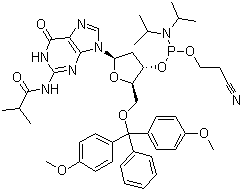 |
| Molecular Formula | C44H54N7O8P |
| Molecular Weight | 839.92 |
| CAS Registry Number | 93183-15-4 |
| EC Number | 685-519-6 |
| SMILES | CC(C)C(=O)NC1=NC2=C(C(=O)N1)N=CN2[C@H]3C[C@@H]([C@H](O3)COC(C4=CC=CC=C4)(C5=CC=C(C=C5)OC)C6=CC=C(C=C6)OC)OP(N(C(C)C)C(C)C)OCCC#N |
| Hazard Symbols |  GHS07 Warning Details GHS07 Warning Details | ||||||||
|---|---|---|---|---|---|---|---|---|---|
| Risk Statements | H319 Details | ||||||||
| Safety Statements | P264+P265-P280-P305+P351+P338-P337+P317 Details | ||||||||
| Hazard Classification | |||||||||
| |||||||||
| SDS | Available | ||||||||
 chemBlink Chemical Story
|
5'-O-(4,4-Dimethoxytrityl)-N-isobutyryl-2'-deoxyguanosine-3'-(2-cyanoethyl-N,N-diisopropyl)phosphoramidite is a protected guanosine phosphoramidite derivative used as a nucleotide building block in the chemical synthesis of DNA oligonucleotides. It belongs to the class of nucleoside phosphoramidites developed for automated solid-phase oligonucleotide synthesis. The compound contains a protected deoxyguanosine unit and a phosphoramidite reactive group that allows controlled incorporation of guanine residues into synthetic DNA strands. The development of phosphoramidite chemistry transformed the field of nucleic acid synthesis. Before the introduction of this approach, chemical preparation of oligonucleotides required lengthy procedures with limited efficiency. The phosphoramidite method provided a practical strategy for automated DNA synthesis by enabling sequential addition of protected nucleoside units with high coupling efficiency. Protected derivatives of the four DNA nucleosides, including guanosine phosphoramidites, became essential reagents for producing defined DNA sequences. The compound is derived from 2'-deoxyguanosine, one of the four nucleosides that form DNA. The molecule contains a guanine base attached to a deoxyribose sugar. In natural DNA, guanine forms specific base-pairing interactions with cytosine through hydrogen bonding. During chemical synthesis, however, reactive groups on guanine must be temporarily protected to prevent unwanted reactions. The exocyclic amino group of guanine is protected by an isobutyryl group. This protection reduces the reactivity of the amino functionality during oligonucleotide assembly while maintaining compatibility with the conditions used in phosphoramidite synthesis. After the DNA chain has been assembled, the protecting group can be removed during the final deprotection process to regenerate the natural guanine structure. The 5'-hydroxyl group of the deoxyribose sugar is protected with a 4,4-dimethoxytrityl group. This bulky aromatic protecting group is widely used in nucleoside chemistry because it can be selectively removed under acidic conditions. During automated DNA synthesis, removal of the dimethoxytrityl group exposes the 5'-hydroxyl group, allowing the next nucleotide to be added in the sequence. The 3'-position of the deoxyribose sugar is converted into a phosphoramidite group. This phosphorus-containing functional group is the key reactive element that enables formation of the DNA phosphate backbone. In the presence of an activator, the phosphoramidite reacts with a free hydroxyl group on a growing oligonucleotide chain to form a new internucleotide linkage. The phosphoramidite portion contains a 2-cyanoethyl protecting group and an N,N-diisopropylamino group. The diisopropylamino group functions as a leaving group during coupling reactions, while the 2-cyanoethyl group protects the phosphorus center during synthesis. These protecting strategies allow repeated cycles of nucleotide addition without premature degradation of the phosphoramidite reagent. The primary application of 5'-O-(4,4-dimethoxytrityl)-N-isobutyryl-2'-deoxyguanosine-3'-(2-cyanoethyl-N,N-diisopropyl)phosphoramidite is in the preparation of synthetic DNA molecules. It is used in automated DNA synthesizers to introduce guanine residues into oligonucleotides used in molecular biology, biotechnology, genetic analysis, and nucleic acid research. Synthetic oligonucleotides produced using guanosine phosphoramidites are important tools in many biological applications. They are used as primers, probes, sequencing reagents, and components of molecular biology techniques. The availability of highly purified protected nucleoside phosphoramidites has enabled the routine production of custom DNA sequences. The physical and chemical properties of this compound are determined by the combination of the polar nucleoside structure, aromatic protecting group, and phosphorus-containing reactive group. The dimethoxytrityl group provides hydrophobic character, while the nucleoside and phosphoramidite portions contain multiple heteroatoms capable of polar interactions. Because phosphoramidites are sensitive to moisture, they are typically handled under dry conditions. Overall, 5'-O-(4,4-dimethoxytrityl)-N-isobutyryl-2'-deoxyguanosine-3'-(2-cyanoethyl-N,N-diisopropyl)phosphoramidite is a specialized protected nucleoside reagent developed for DNA synthesis. Its carefully designed protecting groups allow selective chemical reactions at specific positions of guanosine, making it an essential building block for the controlled preparation of synthetic oligonucleotides. |
| Market Analysis Reports |