
Online Database of Chemicals from Around the World
| Changzhou Ditong Chemical Co., Ltd. | China | |||
|---|---|---|---|---|
 | www.edengenechem.com | |||
 | +86 (519) 8829-8848 +86 18118010980 | |||
 | info@edengenechem.com sale@edengenechem.com | |||
 | QQ Chat | |||
 | WeChat: 18118010980 | |||
| Chemical manufacturer since 2006 | ||||
| chemBlink Premium supplier since 2026 | ||||
| Classification | Pharmaceutical intermediate >> Diphenylamine intermediate |
|---|---|
| Name | 2,4,4'-Trimethyldiphenylamine |
| Synonyms | N-p-Tolyl-2,4-xylidine |
| Molecular Structure | 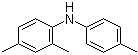 |
| Molecular Formula | C15H17N |
| Molecular Weight | 211.30 |
| CAS Registry Number | 94026-73-0 |
| SMILES | CC1=CC=C(C=C1)NC2=C(C=C(C=C2)C)C |
| Solubility | Insoluble (9.9E-3 g/L) (25 °C), Calc.* |
|---|---|
| Density | 1.034±0.06 g/cm3 (20 °C 760 Torr), Calc.* |
| Boiling point | 344.2±11.0 °C 760 mmHg (Calc.)* |
| Flash point | 169.5±14.7 °C (Calc.)* |
| Index of refraction | 1.602 (Calc.)* |
| * | Calculated using Advanced Chemistry Development (ACD/Labs) Software. |
| Hazard Symbols |  GHS07 Warning Details GHS07 Warning Details |
|---|---|
| Risk Statements | H315-H319-H335 Details |
| Safety Statements | P261-P264-P271-P280-P302+P352-P304+P340-P305+P351+P338-P312-P362-P403+P233-P501 Details |
| SDS | Available |
 chemBlink Chemical Story
|
2,4,4'-Trimethyldiphenylamine is an aromatic amine belonging to the class of substituted diphenylamines. The compound consists of two benzene rings connected through an amino nitrogen atom, with three methyl substituents located at the 2, 4, and 4' positions of the aromatic rings. Its structure combines the electronic characteristics of a diphenylamine framework with the steric and hydrophobic effects introduced by methyl groups, making it useful in the development of specialty organic materials and as an intermediate in chemical synthesis. Diphenylamine derivatives have been studied extensively since the development of aromatic amine chemistry. Diphenylamine itself became an important compound in industrial chemistry because of its applications in antioxidants, dyes, pharmaceuticals, and materials research. Modification of the diphenylamine structure through alkyl substitution has been investigated to adjust electronic properties, solubility, stability, and reactivity. The molecular structure of 2,4,4'-trimethyldiphenylamine contains a nitrogen atom bonded to two aromatic rings. The nitrogen atom has a lone pair of electrons that can interact with the pi-electron systems of the benzene rings. This conjugation gives diphenylamine derivatives characteristic electronic properties and allows them to participate in oxidation-reduction processes. The three methyl substituents attached to the aromatic rings influence the behavior of the molecule. Methyl groups are electron-donating substituents that increase electron density in the aromatic system through hyperconjugation. This effect can modify the reactivity of the aromatic rings and influence the oxidation potential of the nitrogen-containing system. The methyl group at the 2-position is located adjacent to the amino nitrogen and introduces steric effects around the nitrogen center. Such steric effects can influence the orientation of the aromatic rings relative to the nitrogen atom and affect the degree of conjugation between the nitrogen lone pair and the aromatic pi systems. The overall molecular shape is therefore influenced by both electronic and steric factors. The primary importance of 2,4,4'-trimethyldiphenylamine is related to its role as an aromatic amine intermediate and functional organic compound. Substituted diphenylamines have been investigated for applications in materials chemistry because their conjugated structures can participate in electron-transfer processes and contribute to the properties of organic functional materials. Diphenylamine derivatives are used in the preparation of organic compounds with antioxidant, stabilizing, and electronic functions. The ability of the nitrogen atom to undergo reversible oxidation has made many aromatic amines useful in studies of charge transport and redox chemistry. In materials research, substituted aromatic amines have been explored as components of organic electronic materials, including systems used in organic semiconductors and related technologies. Their conjugated aromatic structures allow interaction with electronic states, while alkyl substitution can influence film formation, solubility, and molecular packing. The compound also has value as a synthetic intermediate. The aromatic methyl groups remain stable under many reaction conditions, while the amine nitrogen provides a site for further chemical modification. Reactions involving the nitrogen atom, including oxidation, alkylation, and other transformations, can produce a variety of related aromatic amine derivatives. The physical properties of 2,4,4'-trimethyldiphenylamine are determined by its aromatic framework, nitrogen functionality, and methyl substituents. The molecule contains hydrophobic aromatic and alkyl regions, while the amine nitrogen provides polarity and the ability to participate in weak hydrogen bonding. The balance of these features affects its solubility and interactions with other molecules. Overall, 2,4,4'-trimethyldiphenylamine is a substituted diphenylamine derivative whose significance arises from its aromatic amine structure and modified electronic properties. It serves as a useful compound in organic synthesis and in research involving aromatic amine chemistry, redox behavior, and functional organic materials. |
| Market Analysis Reports |