
Online Database of Chemicals from Around the World
| Changzhou Ditong Chemical Co., Ltd. | China | |||
|---|---|---|---|---|
 | www.edengenechem.com | |||
 | +86 (519) 8829-8848 +86 18118010980 | |||
 | info@edengenechem.com sale@edengenechem.com | |||
 | QQ Chat | |||
 | WeChat: 18118010980 | |||
| Chemical manufacturer since 2006 | ||||
| chemBlink Premium supplier since 2026 | ||||
| Classification | Biochemical >> Amino acids and their derivatives >> Amino alcohol derivative |
|---|---|
| Name | 2-Methoxy-N-(2-methoxyethyl)ethanamine |
| Synonyms | NSC 78431; 2,2'-Dimethoxydiethylamine |
| Molecular Structure | 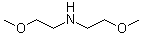 |
| Molecular Formula | C6H15NO2 |
| Molecular Weight | 133.19 |
| CAS Registry Number | 111-95-5 |
| EC Number | 203-923-9 |
| SMILES | COCCNCCOC |
| Solubility | Freely soluble (872 g/L) (25 °C), Calc.* |
|---|---|
| Density | 0.893±0.06 g/cm3 (20 °C 760 Torr), Calc.* |
| Boiling point | 169-170 °C** |
| Refractive index | 1.4211 (589.3 nm 20 °C)*** |
| Flash point | 58.3±0.0 °C, Calc.* |
| * | Calculated using Advanced Chemistry Development (ACD/Labs) Software V11.02 (©1994-2013 ACD/Labs) |
| ** | Harman, Marion W. |
| *** | Remizov, A. L. |
| Hazard Symbols |   GHS02;GHS05 DangerGHS02; Details GHS02;GHS05 DangerGHS02; Details | ||||||||||||||||||||||||
|---|---|---|---|---|---|---|---|---|---|---|---|---|---|---|---|---|---|---|---|---|---|---|---|---|---|
| Risk Statements | H226-H314-H318 Details | ||||||||||||||||||||||||
| Safety Statements | P210-P233-P240-P241-P242-P243-P260-P264-P264+P265-P280-P301+P330+P331-P302+P361+P354-P303+P361+P353-P304+P340-P305+P354+P338-P316-P317-P321-P363-P370+P378-P403+P235-P405-P501 Details | ||||||||||||||||||||||||
| Hazard Classification | |||||||||||||||||||||||||
| |||||||||||||||||||||||||
| Transport Information | UN 2734 8/PG 2 | ||||||||||||||||||||||||
| SDS | Available | ||||||||||||||||||||||||
 chemBlink Chemical Story
|
2-Methoxy-N-(2-methoxyethyl)ethanamine is an aliphatic tertiary amine consisting of two identical 2-methoxyethyl substituents attached to a central nitrogen atom. It belongs to the family of tertiary amino ethers and combines a basic amine center with two ether-containing side chains, resulting in a molecule with moderate polarity and significant conformational flexibility. Structurally, the molecule contains a tertiary amine in which the nitrogen atom is bonded to two 2-methoxyethyl groups and one hydrogen atom has been replaced by the second alkoxyethyl substituent. Each 2-methoxyethyl chain has the structure –CH2CH2OCH3, comprising a two-carbon alkylene spacer terminated by a methoxy group. All carbon atoms in these side chains are sp3-hybridized, allowing free rotation about the carbon–carbon and carbon–oxygen single bonds. The nitrogen atom is sp3-hybridized and adopts a trigonal pyramidal geometry. It possesses a lone pair of electrons that is localized and readily available for protonation or coordination to Lewis acids. Under acidic conditions, the nitrogen accepts a proton to form the corresponding trialkylammonium cation. This acid–base behavior is the principal chemical property of the molecule. Each ether oxygen is also sp3-hybridized and contains two lone pairs of electrons. The ether oxygen atoms function as hydrogen bond acceptors but cannot donate hydrogen bonds because they lack O–H bonds. Their presence increases the polarity of the side chains while maintaining chemical stability under neutral conditions. The methoxyethyl substituents are flexible because they contain only single bonds. Numerous low-energy conformations are possible through rotation around the C–C, C–O, and C–N bonds. This flexibility allows the molecule to adopt different geometries in solution and influences its interactions with solvents and other molecules. From an electronic standpoint, the ether oxygen atoms exert a weak inductive electron-withdrawing effect through the alkylene chains, while the alkyl groups donate electron density to the nitrogen through inductive effects. Because the oxygen atoms are separated from the nitrogen by two carbon atoms, there is little direct resonance interaction between these functional groups. Physicochemically, 2-methoxy-N-(2-methoxyethyl)ethanamine is amphiphilic. The tertiary amine and two ether oxygen atoms provide localized polarity and multiple hydrogen bond acceptor sites, whereas the hydrocarbon portions of the molecule contribute modest hydrophobic character. As a result, the compound exhibits appreciable affinity for polar organic solvents and greater polarity than simple trialkylamines of comparable molecular size. The molecule contains three hydrogen bond acceptor atoms: one tertiary amine nitrogen and two ether oxygen atoms. However, because it contains neither N–H nor O–H bonds, it cannot serve as a hydrogen bond donor in its neutral form. Upon protonation, the resulting ammonium ion becomes capable of donating hydrogen bonds. Chemically, the tertiary amine readily undergoes protonation with mineral or organic acids to form ammonium salts. It can also react with alkylating agents to produce quaternary ammonium compounds. The ether groups are relatively inert under neutral conditions but may undergo cleavage under strongly acidic conditions, particularly in the presence of concentrated hydrohalic acids. The saturated alkyl chains are chemically stable and generally participate only in reactions typical of aliphatic ethers and tertiary amines. The absence of carbon–carbon multiple bonds or aromatic rings contributes to the overall chemical stability of the molecule under ordinary conditions. Overall, 2-methoxy-N-(2-methoxyethyl)ethanamine is a flexible tertiary amino ether composed of a trigonal pyramidal nitrogen center bonded to two 2-methoxyethyl substituents. Its combination of a basic amine, two ether functionalities, and conformationally mobile alkyl chains gives rise to a moderately polar molecule whose chemical behavior is dominated by acid–base chemistry and the stability of its ether linkages. References 2025. Synthesis and Solvatochromism of New Thiazole Derivatives Bearing N,N-Bis(2-methoxyethyl) Benzenesulfonamide Moiety. Journal of Fluorescence. DOI: 10.1007/s10895-025-04430-8 2025. Methylation of reverse osmosis membrane for superior anti-fouling performance via blocking carboxyl groups in polyamide. Nature Water. DOI: 10.1038/s44221-024-00371-x 2024. Dynamic amine sorting enables multiselective construction of unsymmetrical chiral diamines. Nature Chemistry. DOI: 10.1038/s41557-024-01673-z |
| Market Analysis Reports |