
Online Database of Chemicals from Around the World
| Qingdao Free Trade Zone United International Co., Ltd. | China | |||
|---|---|---|---|---|
 | www.unitedint.com | |||
 | +86 (532) 83893696 +86 13808950921 | |||
 | +86 (532) 8389-3695 | |||
 | jason.wang@unitedint.com | |||
 | QQ Chat | |||
| Chemical distributor | ||||
| chemBlink Standard supplier since 2006 | ||||
| Tengzhou Aolong Chemical Co., Ltd. | China | |||
|---|---|---|---|---|
| www.aolongchem.com | |||
| +86 (632) 557-7516 | |||
| +86 (632) 582-6038 | |||
| almky@163.com | |||
| Chemical manufacturer since 1999 | ||||
| chemBlink Standard supplier since 2006 | ||||
| Qindao Baotai Refined Chemical Co., Ltd. | China | |||
|---|---|---|---|---|
| www.baotaichem.com | |||
| +86 (532) 8493-0025 8493-0565 | |||
| +86 (532) 8493-0125 | |||
| baotai@sina.com | |||
| Chemical manufacturer | ||||
| chemBlink Standard supplier since 2007 | ||||
| Simagchem Corporation | China | |||
|---|---|---|---|---|
| www.simagchem.com | |||
| +86 13806087780 | |||
| +86 (592) 268-0237 | |||
| sale@simagchem.com | |||
| Chemical manufacturer since 2002 | ||||
| chemBlink Standard supplier since 2008 | ||||
| Jarchem Industries Inc. | USA | |||
|---|---|---|---|---|
| www.jarchem.com | |||
| +1 (973) 344-0600 | |||
| +1 (973) 344-5743 | |||
| marketing@jarchem.com | |||
| Chemical manufacturer | ||||
| chemBlink Standard supplier since 2009 | ||||
| Hefei TNJ Chemical Industry Co., Ltd. | China | |||
|---|---|---|---|---|
| www.tnjchem.com | |||
| +86 (551) 6541-8684 | |||
| +86 (551) 6541-8697 | |||
| sales@tnjchem.com | |||
| Chemical manufacturer since 2001 | ||||
| chemBlink Standard supplier since 2010 | ||||
| Lianyungang Tongyuan Chemical Industry Co., Ltd. | China | |||
|---|---|---|---|---|
| www.lygtychem.com | |||
| +86 (518) 8532-0599 | |||
| +86 (518) 8108-6178 | |||
| sales@lygtychem.com | |||
| Chemical manufacturer since 2004 | ||||
| chemBlink Standard supplier since 2010 | ||||
| Huabo Biotech Co., Ltd. | China | |||
|---|---|---|---|---|
| www.huabobiotech.com | |||
| +86 (532) 83893696 +86 13808950921 | |||
| +86 (532) 8389-3695 | |||
| jason.wang@unitedint.com | |||
| QQ Chat | |||
| Chemical manufacturer since 2008 | ||||
| chemBlink Standard supplier since 2015 | ||||
| Hangzhou Leap Chem Co., Ltd. | China | |||
|---|---|---|---|---|
| www.leapchem.com | |||
| +86 (571) 8771-1850 | |||
| market19@leapchem.com | |||
| QQ Chat | |||
| Chemical manufacturer since 2006 | ||||
| chemBlink Standard supplier since 2015 | ||||
| Neostar United (Changzhou) Industrial Co., Ltd. | China | |||
|---|---|---|---|---|
| www.neostarunited.com | |||
| +86 (519) 8555-7386 +86 18015025600 | |||
| +86 (519) 8555-7389 | |||
| marketing1@neostarunited.com | |||
| Chemical distributor since 2014 | ||||
| chemBlink Standard supplier since 2020 | ||||
| West Bengal Chemical Industries Limited | India | |||
|---|---|---|---|---|
| www.wbcil.com | |||
| 08240399360 | |||
| wbcilpvtltd@gmail.com | |||
| Chemical manufacturer since 1970 | ||||
| chemBlink Standard supplier since 2021 | ||||
| Bailin Group Co., Ltd. | China | |||
|---|---|---|---|---|
| www.bailincorp.com | |||
| +86 13898102411 | |||
| sybailingroup@gmail.com | |||
| Chemical manufacturer since 2006 | ||||
| chemBlink Standard supplier since 2022 | ||||
| Riverland Trading LLC. | USA | |||
|---|---|---|---|---|
| www.riverlandtrading.com | |||
| +1 (336).944-2293 | |||
| bens@riverlandtrading.com | |||
| Chemical distributor | ||||
| chemBlink Standard supplier since 2023 | ||||
| Mudanjiang Fengda Chemicals Import and Export Co., Ltd. | China | |||
|---|---|---|---|---|
| www.mudanjiangchem.com | |||
| +86 (453) 625-5887 | |||
| +86 (453) 629-6887 / 622-3551 | |||
| fengda@mudanjiangchem.com | |||
 | WeChat: fengdachem | |||
 | WhatsApp:+8615645398875 | |||
| Chemical distributor since 1995 | ||||
| chemBlink Standard supplier since 2026 | ||||
| Classification | Organic raw materials >> Organometallic compound >> Organic calcium |
|---|---|
| Name | Calcium dipropionate |
| Synonyms | Calcium propionate |
| Molecular Structure | 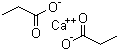 |
| Molecular Formula | 2(C3H6O2).Ca |
| Molecular Weight | 186.24 |
| CAS Registry Number | 4075-81-4 |
| EC Number | 223-795-8 |
| SMILES | CCC(=O)[O-].CCC(=O)[O-].[Ca+2] |
| Melting point | 300 °C (Expl.) |
|---|---|
| Solubility | water: soluble 1 g/10 mL (Expl.) |
| Hazard Symbols |  GHS05 Danger Details GHS05 Danger Details | ||||||||||||||||||||
|---|---|---|---|---|---|---|---|---|---|---|---|---|---|---|---|---|---|---|---|---|---|
| Risk Statements | H318 Details | ||||||||||||||||||||
| Safety Statements | P264+P265-P280-P305+P354+P338-P317 Details | ||||||||||||||||||||
| Hazard Classification | |||||||||||||||||||||
| |||||||||||||||||||||
| SDS | Available | ||||||||||||||||||||
 chemBlink Chemical Story
|
Calcium dipropionate, CAS 4075-81-4, is better known as calcium propionate, the calcium salt of propionic acid. Its formula is Ca(C2H5COO)2, or C6H10CaO4, and its molecular weight is approximately 186.22. It is widely used as an antimicrobial preservative, particularly in baked goods, where it helps delay the growth of molds and thereby extends useful shelf life. Bread presents microorganisms with an attractive environment. It contains water, carbohydrates, minerals, and other nutrients, and after baking it can acquire mold spores from air, equipment, packaging, or handling. Baking destroys many microorganisms originally present in the dough, but it does not keep the finished loaf sterile once it enters the surrounding environment. Given sufficient moisture and time, mold can begin growing on the surface. Calcium propionate helps interfere with that process, but the chemistry is more interesting than simply saying that "calcium propionate kills mold." When the salt dissolves in the water present in food, it provides calcium ions and propionate ions. Propionate is the conjugate base of propionic acid, so the two forms exist in an acid-base equilibrium: C2H5COOH ⇌ H+ + C2H5COO− The position of this equilibrium depends strongly on pH. In a sufficiently acidic food, part of the propionate exists as undissociated propionic acid. This neutral form can cross microbial cell membranes more readily than the charged propionate ion. Once inside a microbial cell, where conditions are closer to neutral, a larger fraction of the acid dissociates. Protons and propionate accumulate, disturbing intracellular pH control and imposing a metabolic burden on the organism. The cell must expend energy maintaining its internal environment, while propionate can also interfere with metabolic processes. Susceptible molds therefore grow more slowly or may fail to establish themselves under conditions in which they otherwise would flourish. This explains an important practical feature of propionate preservatives: effectiveness depends on pH. Propionic acid has a pKa of about 4.87. At lower pH, a larger fraction is present in the undissociated acid form that can enter microbial cells. As pH rises, more exists as negatively charged propionate and antimicrobial effectiveness generally decreases. Food preservation therefore depends not only on how much preservative is added but also on the chemical environment in which it must work. Why use calcium propionate rather than simply adding propionic acid? Propionic acid is a liquid with a strong, pungent odor and can be inconvenient to handle directly. Its calcium salt is a stable solid that is easier to weigh, transport, store, and incorporate into dry food formulations. Once incorporated into an appropriately acidic food, acid-base chemistry generates the equilibrium between propionate and propionic acid needed for preservative action. Bread is an especially suitable application because molds are a major cause of spoilage, while baker's yeast must perform its useful fermentation before baking. Propionates have therefore become closely associated with commercial bread and other baked products. Formulation still requires balance: preservative concentration, dough pH, product moisture, packaging, sanitation, and desired shelf life all influence the final result. Propionate chemistry also has a natural biological connection. Propionic acid is not merely an industrial preservative invented for packaged food. It is a naturally occurring short-chain fatty acid produced by microorganisms in several biological environments. Propionic-acid-producing bacteria are particularly important in the fermentation of Swiss-type cheeses, where metabolism of lactate generates propionate, acetate, and carbon dioxide. The carbon dioxide produced during this fermentation contributes to the characteristic holes, traditionally called eyes, in cheeses such as Emmental. Propionic acid and related metabolites also contribute to characteristic flavor development. Thus, the same small three-carbon acid family connects two apparently different food technologies: in bread, propionate is deliberately used to discourage unwanted fungal growth; in certain cheeses, microbial production of propionate is part of the fermentation that creates the desired product. Calcium propionate also has applications beyond human food. Propionate salts are used to help control molds in animal feeds and stored agricultural materials, where fungal growth can cause spoilage, nutrient loss, heating, and in some circumstances production of undesirable fungal metabolites. Again, successful preservation depends on moisture, pH, microbial population, dosage, and storage conditions rather than on the preservative alone. The compound provides a useful lesson in how preservatives actually work. A preservative does not necessarily sterilize food, nor does it make deterioration impossible. Instead, it changes the chemical environment enough to make growth more difficult for particular microorganisms. Combined with baking, sanitation, moisture control, packaging, and appropriate storage, that delay can translate into substantially longer shelf life. Calcium propionate also demonstrates why acid-base equilibria have consequences far beyond a chemistry classroom. The equation between propionic acid and propionate looks simple, but it determines how much of the preservative can cross microbial membranes and therefore influences whether mold can successfully colonize a loaf of bread. The next time a packaged loaf remains free of visible mold longer than an untreated loaf might, the explanation may involve a small equilibrium operating in the microscopic water phase of the bread. Calcium propionate is added as a convenient solid salt, but its effectiveness ultimately depends on an old and fundamental piece of chemistry: weak acids change form when pH changes. References 1. U.S. Food and Drug Administration. 21 CFR 184.1221. Calcium propionate. Recognition and use as an antimicrobial agent and other food applications. 2. International Programme on Chemical Safety. Propionic acid and its calcium, sodium, and potassium salts. Chemical and food-use information. 3. Eklund, T. (1983). "The antimicrobial effect of dissociated and undissociated sorbic acid at different pH levels." Journal of Applied Bacteriology. General weak-acid preservative principles. 4. Published food microbiology literature on propionic acid and propionates as inhibitors of molds in bakery products. 5. Published dairy microbiology literature on propionic-acid fermentation in Swiss-type cheeses. |
| Market Analysis Reports |